Wednesday, January 8, 2014
Evernote for Genealogists Quick Guides Now Available
Thursday, January 31, 2013
Zap the Grandma Gap: A Review
Monday, January 14, 2013
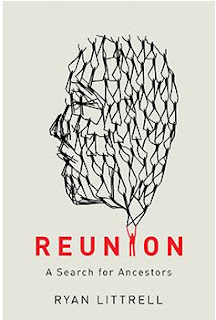
Reunion: A Search for Ancestors by Ryan Littrell
Monday, May 28, 2012
Book Review: Cajun by Any Other Name
Cajun by Any Other Name* focuses on the history of one person’s Acadian, Native American and European ancestral lines. Author Marie Rundquist shares the relocation and establishment of her ancestors from Canada to Louisiana.
* affiliate link
Cajun by Any Other Name*
by Marie Rundquist
ISBN - 978-0-7414-7042-X
$11.95
Sunday, May 13, 2012
Book review: On the Banks of Plaquemine Brulee by Gene Thibodeaux
My own interest in this book stems from my connection to the area. My great-great grandparents Noel Thibodeaux and Eliza Eldridge were married there. You may remember Noel as the one with the wandering eye.
Thibodeaux's book is organized into eighteen chapters, sorted by time period. The first chapter begins with the Native American history of the area. Later chapters each cover a set time period and the events that occurred during that time.
A typical chapter includes and overview of the national, state and local history of the era. Notable events, social changes and disasters are included. Readers will get a detailed picture of the region, it's economy and local flavor.
On the Banks of the Plaquemine Brulee is a history book with value to genealogists. Thibodeaux includes many names of Church Point citizens and their role in the city's history. A name index is included in the back of the book.
Numerous black and white photographs are featured in certain sections of the book. Thibodeaux also included an impressive source list and several appendixes featuring lists of names in historic Church Point groups, censuses, etc.
On the Banks of the Plaquemine Brulee is a well written, thoroughly researched look at a slice of Acadiana. It helped me get a sense of the former home of my ancestors and learn more about Louisiana. It also makes me wonder if I'm distantly related to the author through my Thibodeaux line. That's a search for another day, however. For now I'll just be content with my new knowledge of Church Point, Louisiana.
Information on ordering the book can be found here.
Friday, March 23, 2012
Branching Out: Genealogy for High School, a review
Wednesday, October 26, 2011
The Genealogist's Guide to Researching Tax Records
Tuesday, May 17, 2011
Book Review: The Time Traveller's Handbook by Althea Douglas
Monday, February 28, 2011
Book Review: Life in Civil War America
Tuesday, January 4, 2011
Tracing Your Civil War Ancestors: Book Review
Tuesday, May 4, 2010
Book Review of Who Do You Think You Are?
Tuesday, February 9, 2010
Book Review of Presentation Zen
Tuesday, January 5, 2010
Book Review: How to Do Everything Genealogy
“How to do Everything ___” is a popular series of books in the same vein as the “The Complete Idiot’s Guide to___” and “___For Dummies” introductory subject guides. George G. Morgan wrote the original How to Do Everything (with Your) Genealogy and also updated the second edition featured here.
The title is no joke. Morgan somehow manages to touch on every aspect one might encounter in the general genealogy field. Chapter subjects include topics on why one should do genealogy, family tree organization, traditional & electronic resources, accessing different types of records (military, land, etc.), DNA, problem solving, research trip planning, technology and more.
Each chapter includes “Did You Know?”text boxes with handy facts for benefit of readers. Morgan also shares documents from his private collection and features them as examples throughout the book.
The center of How to Do Everything Genealogy contains a highlighted section that includes a brick-wall research problem. In “Getting Past Penelope Swords,” Morgan shares some hurdles in a genealogy quest and provides alternative research strategies readers can employ in their own family history pursuits.
The vast level of content covered in this book makes it a good starting point for those just beginning their genealogy quests. Morgan does not go into depth with these topics (there’s simply not enough room), but he introduces the terms, explains them and provides suggestions for further information. Intermediate researchers may also learn some new tricks and be reminded of old ones.
“Become an expert genealogical researcher,” claims the book’s cover. This ambitious statement is more likely from the publisher’s art department than the author himself. Reading How to Do Everything Genealogy will not make you an expert, but it will provide a solid foundation on which new genealogists can build.
How to Do Everything Genealogy by George G. Morgan
McGraw-Hill Osborne Media
ISBN-13: 978-0071625340
Monday, December 7, 2009
Book Review of The Genealogist's Address Book
The Genealogist’s Address Book provides almost 800 pages of state and local genealogy resources. Elizabeth Petty Bentley has compiled an amazing amount of information and genealogy contacts in this recently updated 6th edition.
The Genealogist’s Address Book – 6th Edition
Elizabeth Petty Bentley
ISBN 978-0-8063-1796-0
Genealogical Publishing Company
[Edit 12 Jan 2010: Comments on this post are currently suspended due to spam (in Spanish, no less). If you have any comments, you can email me at the address I listed in the sidebar of this blog. Thanks. --Amy]
Thursday, November 5, 2009
Book Review of The Family Tree Problem Solver
The Family Tree Problem Solver provides “proven methods for scaling the inevitable brick wall.” Author Marsha Hoffman Rising CG, FASG is a professional genealogist who specializes in problem-solving in the nineteenth century. In this book, she draws on her experience to highlight certain common genealogical problems and provides the steps to solve them.
The Family Tree Problem Solver by Marsha Hoffman Rising. ISBN 1-55870-685-2, paperback, 240 pages.
Monday, October 26, 2009
Book Review of Getting the Most Out of RootsMagic 4
RootsMagic 4 is the latest edition of a popular genealogy software series. The program allows family historians, hobbyists and professionals to record ancestral lines, create family trees, publish documents and more based on user preferences. Though it’s easy to get started with the program, there are so many features that users may miss some while concentrating on others. How do you know what you don’t know about RootsMagic 4? Fortunately, there’s a book to enlighten readers on all the features the program has to offer.