In the series I wrote about going to the Family History Library last month, I mentioned that the experience of having access to so many microfilms at one time allowed me to see how records were organized on the films. This also changed the way I approach my research logs.
Several readers have asked me to elaborate on this. It is difficult to put into words, because my organizational system only makes sense to me. However, I will give it my best shot.
My research logs are mostly focused on events or people. For example, if I'm looking for a marriage date, all the information I have previously covered will be found in the notes for those two people in my database. I use RootsMagic. It has a "to-do list" feature and that's how I use it.
So if I'm searching for a marriage record for John and Mary Smith, the research notes for those people (or that fact in my database) will include the books I have checked, the county offices at which I've inquired, the FHL microfilms I've reviewed, etc, in search of a record. My intent is to know what I've already done so I don't repeat the same searches.
However, my week at the Family History Library gave me lots of time to see lots of records for a given area. Not all the marriage records for a county are on a single roll or concurrent rolls. Sometimes they're mixed up with the tax records, etc. On a given roll, item 1 could be marriages 1900-1904, items 2-3 could be tax rolls 1886-1887, etc.
I never noticed this because at home I can only order a couple film rolls at a time. The ones I've ordered thus far aren't as varied as all the ones I saw in Salt Lake City.
Now I see that my research logs also need to focus on the numbered film rolls, too, not just the event or person. So my notes will tell me that I have already looked at every single frame of film #1234567. That way, I won't order the same film multiple times, once for 1880's tax records, once for 1900's marriage records, etc. I will know I've already seen the whole thing, saving me time and money.
Hopefully I explained this right. Normally I don't comment on my own system or that of others because everyone does it a little differently. There is no right or wrong, just what works for you. And this adjustment is what works for me.
Showing posts with label FHL. Show all posts
Showing posts with label FHL. Show all posts
Wednesday, November 10, 2010


Friday, November 5, 2010
Family History Library Research Retreat, part 4
See part 1 here, part 2 here, and part 3 here.
So what did I learn from my week at the Family History Expos research retreat at the Family History Library?
1. I viewed 66 microfilm rolls. It costs me $5.50 per film to rent them at my local Family History Center (FHC). Therefore, I viewed $363.00 worth of microfilm during the week.
2. It takes several weeks to order a roll of film and have it delivered to a FHC. You can do the math and see how long it would have taken me to view all of these records at home.
3. I got a chance to see how records are organized on the rolls. Many types of records can be on one roll. The way I currently log my research will be improved because of this trip. I see now that I can record this information better, and I will.
4. The flash drive was the best way for me to retrieve records. I took home 329 images. That's a lot of work for me to record and add to my database!
All genealogists should experience the Family History Library at some point. All of these records are at your fingertips:

And all you have to do is go get them:

Family History Expos hosts research retreats in April and October of each year. I had a great time and would be happy to answer any questions about the event. Feel free to email me at the address provided i the right column of this blog.
[Please see my Disclosures page for information on my connection to Family History Expos. --Amy]
So what did I learn from my week at the Family History Expos research retreat at the Family History Library?
1. I viewed 66 microfilm rolls. It costs me $5.50 per film to rent them at my local Family History Center (FHC). Therefore, I viewed $363.00 worth of microfilm during the week.
2. It takes several weeks to order a roll of film and have it delivered to a FHC. You can do the math and see how long it would have taken me to view all of these records at home.
3. I got a chance to see how records are organized on the rolls. Many types of records can be on one roll. The way I currently log my research will be improved because of this trip. I see now that I can record this information better, and I will.
4. The flash drive was the best way for me to retrieve records. I took home 329 images. That's a lot of work for me to record and add to my database!
All genealogists should experience the Family History Library at some point. All of these records are at your fingertips:

And all you have to do is go get them:

Family History Expos hosts research retreats in April and October of each year. I had a great time and would be happy to answer any questions about the event. Feel free to email me at the address provided i the right column of this blog.
[Please see my Disclosures page for information on my connection to Family History Expos. --Amy]
Thursday, November 4, 2010
Family History Library Research Retreat, part 3
See part 1 here and part 2 here.
As part of their Family History Library research retreats, Family History Expos provides access to professional genealogists to guide attendees with their research as well as provide advice and instruction. Because I had a good idea of the information I needed, I didn't get to take advantage of that perk as much as others did.
On Friday, I did inquire about the resources available for Indian Territory. My ancestors lived in Oklahoma before it was Oklahoma. Who has those records and how can I get them? My biggest problem is that I don't know what I don't know about these resources. The expert provided me some great leads. I took home a lot of information that will benefit me for years to come.
I also inquired about a German marriage record at the Europe reference desk at the Family History Library. A very knowledgeable woman told me the FHL did not carry the marriage record because it was too recent. She showed me where to write for it in Germany. She also told me exactly what to write in order to get the best response. I was deeply grateful for her advice. She saved me time and increased my chances of getting an answer.
Saturday, I spent the morning in the U.S. book section. I spent the afternoon gathering Pope County, Arkansas tax records from the late 1800's.
In the evening, Family History Expos president Holly Hansen hosted a little party for the attendees. We talked about our research success stories and viewed a slide show of the week's events:

There was even a cake! It was so good that people started cutting pieces before I could get a picture of the whole thing:

I spent Saturday evening reflecting on all I had accomplished. The short answer was "a lot." The long answer requires another post.
On to part 4 here.
[Please see my Disclosures page for information on my connection to Family History Expos. --Amy]
As part of their Family History Library research retreats, Family History Expos provides access to professional genealogists to guide attendees with their research as well as provide advice and instruction. Because I had a good idea of the information I needed, I didn't get to take advantage of that perk as much as others did.
On Friday, I did inquire about the resources available for Indian Territory. My ancestors lived in Oklahoma before it was Oklahoma. Who has those records and how can I get them? My biggest problem is that I don't know what I don't know about these resources. The expert provided me some great leads. I took home a lot of information that will benefit me for years to come.
I also inquired about a German marriage record at the Europe reference desk at the Family History Library. A very knowledgeable woman told me the FHL did not carry the marriage record because it was too recent. She showed me where to write for it in Germany. She also told me exactly what to write in order to get the best response. I was deeply grateful for her advice. She saved me time and increased my chances of getting an answer.
Saturday, I spent the morning in the U.S. book section. I spent the afternoon gathering Pope County, Arkansas tax records from the late 1800's.
In the evening, Family History Expos president Holly Hansen hosted a little party for the attendees. We talked about our research success stories and viewed a slide show of the week's events:

There was even a cake! It was so good that people started cutting pieces before I could get a picture of the whole thing:

I spent Saturday evening reflecting on all I had accomplished. The short answer was "a lot." The long answer requires another post.
On to part 4 here.
[Please see my Disclosures page for information on my connection to Family History Expos. --Amy]
Wednesday, November 3, 2010
Family History Library Research Retreat, part 2
See part 1 here.
With my first full day of FHL research behind me, I returned each morning with a plan. The second day, I sought and located marriage records for my Lenertz line in Blue Earth county, Minnesota. There wasn't much groundbreaking research going on. I knew what I needed and I found it. Most of the records were to help me add more information to my 100% cited family tree.

One of the more interesting things I found was a record of physicians in Stephens County, Oklahoma. My great-grandfather, his uncle and a cousin were all included there. I also found a ton of marriage records. I knew the dates, I just needed the records for them to be legit in the eyes of the genealogy police.
I spent most of my week at left-handed reader 6-L on the United States floor. It was usually quiet in my row because, well...it's a right-handed world out there:

What makes it left-handed? The handle is on the left. Really, I could deal with either handle, but I needed the lefty writing space for mymess research.

My biggest challenge of the week was the search for and location of probate records for my 4th great-grandfather John McElroy Bourland. I first checked the indexes and dutifully wrote down the pages where I should find the records. However, the pages didn't correspond. Finally, after a page-by-page inspection of the film, I found an estate list for Bourland and then finally all of the related records. This entire process took six hours, plus another to acquire copies of all the documents. Persistence paid off.
On to part 3 here.
[Please see my Disclosures page for information on my connection to Family History Expos. --Amy]
With my first full day of FHL research behind me, I returned each morning with a plan. The second day, I sought and located marriage records for my Lenertz line in Blue Earth county, Minnesota. There wasn't much groundbreaking research going on. I knew what I needed and I found it. Most of the records were to help me add more information to my 100% cited family tree.
One of the more interesting things I found was a record of physicians in Stephens County, Oklahoma. My great-grandfather, his uncle and a cousin were all included there. I also found a ton of marriage records. I knew the dates, I just needed the records for them to be legit in the eyes of the genealogy police.
I spent most of my week at left-handed reader 6-L on the United States floor. It was usually quiet in my row because, well...it's a right-handed world out there:

What makes it left-handed? The handle is on the left. Really, I could deal with either handle, but I needed the lefty writing space for my

My biggest challenge of the week was the search for and location of probate records for my 4th great-grandfather John McElroy Bourland. I first checked the indexes and dutifully wrote down the pages where I should find the records. However, the pages didn't correspond. Finally, after a page-by-page inspection of the film, I found an estate list for Bourland and then finally all of the related records. This entire process took six hours, plus another to acquire copies of all the documents. Persistence paid off.
On to part 3 here.
[Please see my Disclosures page for information on my connection to Family History Expos. --Amy]
Tuesday, November 2, 2010
Family History Library Research Retreat, part 1
Last week, I had the fortune of attending the Family History Expos research retreat at the Family History Library.* The event included 5 full days of research at the library, morning / evening classes and access to genealogy professionals. I thought it might be nice to describe my week so you can see what a research retreat entails.
I arrived in Salt Lake City on Monday. That evening, Family History Expos held a pizza/salad dinner for all of the research retreat attendees. We got to meet each other and the professionals that would be helping us with our research.
Tuesday morning came quickly. I woke up to this view after an overnight dusting of snow:
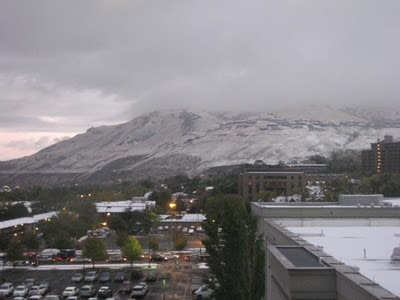
We had a morning class about resources in the Family History Library. For those that had never been to the Family History Library, there was a tour of the floors, their collections and more. Then it was time to leave the nest and start researching!

I came with a plan and a shopping list of things I wanted to research. I started with my great-grandparents' marriage. I only had a date range (1915-1916) and an area (counties surrounding Lehigh, PA). I searched all the available records with lightning speed. Once I was done with one county, I retrieved the film of another. If I had done this from home, I'd be ordering the films one or two at a time. It would have taken months to get this far!
My first day at the Family History Library didn't bring any great discoveries in Pennsylvania, but that's part of the research process. I omitted several counties where the marriage did not take place. It's not an answer, but it's progress.
In the afternoon, I researched my Smith line, including my third great-grandparents with the oh-so-uncommon monikers Joseph and Mary Smith. I figured the FHL was the best place to do it, since I would need quick access to lots of records.
I found several Smith deaths in LeSueur County, Minnesota, including a record for Joseph Smith. He apparently died in 1903 (in his 70's) of an infection incurred from an injury seven days prior. What a way to go. The record also gave me the names of his parents! Wanna know who my fourth great-grandparents are? John and Elizabeth Smith. Why can't I get an Ebeneezer in this line?
See part 2 here.
[*Please see my Disclosures page for information on my connection to Family History Expos. --Amy]
I arrived in Salt Lake City on Monday. That evening, Family History Expos held a pizza/salad dinner for all of the research retreat attendees. We got to meet each other and the professionals that would be helping us with our research.
Tuesday morning came quickly. I woke up to this view after an overnight dusting of snow:

We had a morning class about resources in the Family History Library. For those that had never been to the Family History Library, there was a tour of the floors, their collections and more. Then it was time to leave the nest and start researching!

I came with a plan and a shopping list of things I wanted to research. I started with my great-grandparents' marriage. I only had a date range (1915-1916) and an area (counties surrounding Lehigh, PA). I searched all the available records with lightning speed. Once I was done with one county, I retrieved the film of another. If I had done this from home, I'd be ordering the films one or two at a time. It would have taken months to get this far!
My first day at the Family History Library didn't bring any great discoveries in Pennsylvania, but that's part of the research process. I omitted several counties where the marriage did not take place. It's not an answer, but it's progress.
In the afternoon, I researched my Smith line, including my third great-grandparents with the oh-so-uncommon monikers Joseph and Mary Smith. I figured the FHL was the best place to do it, since I would need quick access to lots of records.
I found several Smith deaths in LeSueur County, Minnesota, including a record for Joseph Smith. He apparently died in 1903 (in his 70's) of an infection incurred from an injury seven days prior. What a way to go. The record also gave me the names of his parents! Wanna know who my fourth great-grandparents are? John and Elizabeth Smith. Why can't I get an Ebeneezer in this line?
See part 2 here.
[*Please see my Disclosures page for information on my connection to Family History Expos. --Amy]
Tuesday, February 16, 2010
The Films are In
When you order items from the Family History Library, it takes a few weeks for them to arrive at your local Family History Center. So you wait and wait to hear the four magic words: "The Films are In."
That's the call I received this Saturday. The films in question are marriage and death records for 1890's Milwaukee, Wisconsin. My great-great grandparents were married there April 25, 1891 and my great-great grandfather died there October 27, 1896. I received these details from indexes at Ancestry.com. I am hoping these films provide the records I need.
I haven't had good luck at the Family History Center lately. I can't find a will for John Laurens Williamson. There are lots of references to a will, but no will.
Last week, I poured over the early 20th century marriage records for Duncan, Oklahoma. I need the marriage dates for six daughters: my great-grandmother and her five sisters. The records began in November 1907. My great-grandmother was married in October 1907. Ouch. I found records for two of the ladies. 2 out of 6. Also, the records were computerized, which was disappointing. I was hoping for microfiche of the originals.
So now I sit here and wait for the FHC to open so I can look at the Milwaukee films. Will my great-great grandparents' marriage record be there? Might it hold the previously unknown identity of my great-great-great grandfather? I guess I'll just have to wait and see, cross my fingers and hope.
That's the call I received this Saturday. The films in question are marriage and death records for 1890's Milwaukee, Wisconsin. My great-great grandparents were married there April 25, 1891 and my great-great grandfather died there October 27, 1896. I received these details from indexes at Ancestry.com. I am hoping these films provide the records I need.
I haven't had good luck at the Family History Center lately. I can't find a will for John Laurens Williamson. There are lots of references to a will, but no will.
Last week, I poured over the early 20th century marriage records for Duncan, Oklahoma. I need the marriage dates for six daughters: my great-grandmother and her five sisters. The records began in November 1907. My great-grandmother was married in October 1907. Ouch. I found records for two of the ladies. 2 out of 6. Also, the records were computerized, which was disappointing. I was hoping for microfiche of the originals.
So now I sit here and wait for the FHC to open so I can look at the Milwaukee films. Will my great-great grandparents' marriage record be there? Might it hold the previously unknown identity of my great-great-great grandfather? I guess I'll just have to wait and see, cross my fingers and hope.
Thursday, February 11, 2010
From the Clayton: I Ask Questions, You Get Answers
Yesterday, on my way out the door of the Clayton Library, I stopped by the bookshelves that hold the "World" genealogy books, but the shelves were half-empty, half-filled with the "United States" books. The staff were moving the U.S. books, but where were the World ones? The librarian at the desk said they were in the back on the first floor. The staff member didn't give a specific location and I didn't press. I'm just glad to know they're still with us. There are some empty shelves, though, and that always makes me nervous that they're weeding the exact items I need. So if you're looking for the World books, they're in a new place.
I also asked the desk librarian if the Family History Library films on permanent loan at the Clayton are in the Houston Public Library Catalog. Let me explain: the Clayton library recently became a designated Family History Center, meaning you can order films from the FHL and have them delivered to the Clayton where you can view them. If you re-order/check-out your films twice, they are designated as on permanent loan and stay at the Clayton. I wanted to know if I can see what's on permanent loan through the Clayton's online catalog (which is the Houston Public Library). The answer the staff member told me was no, since the items belong to the Family History Library. However, there is a list of permanent loan items on the Clayton library premises, so you can see it there. Because Clayton's FHC designation is pretty new, they don't have a big collection of permanent-loan films. Expect that to change as time goes on.
I also asked the desk librarian if the Family History Library films on permanent loan at the Clayton are in the Houston Public Library Catalog. Let me explain: the Clayton library recently became a designated Family History Center, meaning you can order films from the FHL and have them delivered to the Clayton where you can view them. If you re-order/check-out your films twice, they are designated as on permanent loan and stay at the Clayton. I wanted to know if I can see what's on permanent loan through the Clayton's online catalog (which is the Houston Public Library). The answer the staff member told me was no, since the items belong to the Family History Library. However, there is a list of permanent loan items on the Clayton library premises, so you can see it there. Because Clayton's FHC designation is pretty new, they don't have a big collection of permanent-loan films. Expect that to change as time goes on.
Tuesday, November 3, 2009
Where Did You Get the Microfilm?
Yesterday, in my Don't Forget the Spinster Aunt post, I wrote about the will of an unmarried aunt. Marti of The Next Fifty Years blog asked a great question: "how did you get the microfilm that held the will?" Instead of replying in the comments section, I decided the question and answer were worthy of their own post.
I accessed the microfilm at my local Family History Center. You can find the one nearest to you at this page. Questions about Family History Centers are answered here. More information on what to expect during a visit can be found here. It is a common misconception that one must be a LDS church member to utilize the facilities. This is not true. I am not a member and have had all positive experiences.
I located the microfilm of Pope County, Arkansas wills by checking the Family History Library catalog. I clicked the "Place Search" button. Then I put "Pope" in the place box and "Arkansas" in the part of box and hit enter. I was given one link says "Arkansas, Pope," so I clicked that. Numerous results are shown. I chose "Arkansas, Pope - Probate Records."
One of the titles I was shown was Probate court records, 1830-1978. I then clicked the "View Film Notes" button in the top right of the screen. The first film listed is #1034017.
I wrote down the film number and took it to my Family History Center. I filled out a little form and paid a $5.50 rental fee. 2-3 weeks later, the film arrived from Salt Lake City. The film stays at my FHC and I use their readers. My last day with the film is Nov. 20, but I'll probably renew for another session.
So that's how I got the microfilm that held the will of my spinster aunt. Hopefully I answered Marti's question and maybe yours. If not, just let me know and I'll give it another shot.
Tuesday, May 5, 2009
Do Not Pass Go. Do Not Collect $200
You may recall that in March I went to the San Miguel County, New Mexico courthouse on a records hunt, only to find the building gutted and the records completely inaccessible.
My backup plan was to order microfilms for the dates I believe my great-great grandmother married her second husband. I ordered those films and waited.
Today I got the call that the microfilms are "restricted" and I cannot have them. Specifically films #1574070 and #1542780, are on the naughty list. Both films deal with San Miguel County (NM) marriage records circa 1900--well over 100 years old.
I assume the restriction was placed by whoever provided the records and not the Family History Library itself. I was so surprised, I forgot to ask if that was the case of the volunteer that had to break the news to me.
I don't have much experience with New Mexico records and I don't know much about the time my ancestors were there. Mostly I don't know much about them because I'm having such a hard time getting information.
Has anybody dealt with "restricted" microfilms? Can I get them in Salt Lake City? or would I be denied there, too? With both the courthouse and the FHL out of the question, I'm running out of ideas on how to find a record for a marriage that took place probably between 1898-1901 in Las Vegas, New Mexico.
Sigh...
I'd be more bummed but I have to go be a mom right now.
My backup plan was to order microfilms for the dates I believe my great-great grandmother married her second husband. I ordered those films and waited.
Today I got the call that the microfilms are "restricted" and I cannot have them. Specifically films #1574070 and #1542780, are on the naughty list. Both films deal with San Miguel County (NM) marriage records circa 1900--well over 100 years old.
I assume the restriction was placed by whoever provided the records and not the Family History Library itself. I was so surprised, I forgot to ask if that was the case of the volunteer that had to break the news to me.
I don't have much experience with New Mexico records and I don't know much about the time my ancestors were there. Mostly I don't know much about them because I'm having such a hard time getting information.
Has anybody dealt with "restricted" microfilms? Can I get them in Salt Lake City? or would I be denied there, too? With both the courthouse and the FHL out of the question, I'm running out of ideas on how to find a record for a marriage that took place probably between 1898-1901 in Las Vegas, New Mexico.
Sigh...
I'd be more bummed but I have to go be a mom right now.
Subscribe to:
Posts (Atom)