Tuesday, November 30, 2010
Get Ready for the Advent Calendar of Christmas Memories
The Advent Calendar of Christmas Memories starts tomorrow. If you have a genealogy blog, I encourage you to join in the fun.
All you need to know is found at the Advent Calendar of Christmas Memories blog. There are prompts for each day. Do one, a few or all of them. It's up to you.
I will be reposting memories from the past this year. I hope you enjoy them!
Monday, November 29, 2010
Win a copy of RootsMagic 4!
Exciting news! I cleaned out my genealogy closet!
But wait....there's more!
In said closet, I found two copies of RootsMagic 4 genealogy software that were part of genealogy gift bags I received at conferences. I already have my own copy, so I've decided to give these away to two of my loyal, wonderful blog readers. Think of it as an early holiday present for you!
Here's the deal:
The fairest way I can think of to give everyone an equal chance is a random drawing. Send me an email at [Redacted. Contest over.] with RootsMagic in the subject line. You can enter now through 11:59PM Central Time on Sunday December 5, 2010. Each email will be numbered in the order in which they landed in the email box. On Monday, Dec. 6, I will randomly draw two numbers and announce the winners. These lucky folks will each be sent a FREE copy of RootsMagic 4.
This little event is open to blog readers in the U.S. and Canada only. Sorry, but postage rates make it so.
Anyone who does not already own a copy of RootsMagic 4 is eligible. Owners of earlier editions of RootsMagic are welcome to enter the drawing, as RootsMagic 4 is completely different than what you own.
Genealogy bloggers, feel free to let your readers know about this drawing. It's all about spreading some genealogy love (and cleaning out closets).
Guess that's it. Good luck to everyone!
Sunday, November 28, 2010
Deadline Approaching for the 2011 Family Tree 40 Nominations
Saturday, November 27, 2010
COG 100: There's One in Every Family
The topic for the 100th Carnival of Genealogy is "there's one in every family." One what, you ask? Well, it's up to each blogger to individually interpret and answer that question.
I'm always drawn to tall tales in family history: gossip about minor crimes, moonshiners, supposed ties to famous people, and the like. Everybody seems to have a tale, yet no one can provide a source for the information. They just heard the details as they were passed down through generations.
My own family has it's share of said lore. However, in researching our history, I noticed that many of the tall tales seem to be tied to the same ancestor. Moreover, the more I learn about that person, the more the tales prove to be true.
Who is the "one" in my family? No contest, it is my great-grandfather, Noel Holly Thibodeaux (1889-1962).
Here is the short story on Noel (known as Holly, but that confuses people so I'll stay with Noel). He grew up in French-speaking Louisiana. He never knew his father (who was the subject of my 57th COG entry). He struck out on his own as a teen, lying about his age as he crossed the country.
The collected records and interviews in my possession tell me he was a charmer. That must have been how he snagged such a pretty young wife from an upstanding Acadian family. I can't find a marriage record for them. Did her family disapprove? Did the young couple elope? Perhaps they traveled to New Orleans.
The tales tied to Noel include gambling, gunshots, kidnapping, boxing, jail time, Huey Long and "delivery fulfillment" during prohibition. At one point, he supposedly won significant southern California land holdings in a poker game. At another point, he supposedly lost his New Orleans tailor business the same way. Were either of these true? I don't know, but records put him in the right place and time for both, and the 1920 census confirms the tailor shop connection.
From 1917 through through the 1940's the Noel Thibodeaux family moved dozens of times to, from and around Louisiana and California. Was Noel looking for work or staying two steps ahead of the landlord and the law? The answer is probably all of the above.
Each family member I talk to has a different Noel Thibodeaux tale. So many so that it seems impossible that they could all be true. But you know what? The more I learn about my great-grandfather, the more these stories are fitting with the facts.
However, what makes Noel the "one" is the strong, affectionate impression he made on his family. For each tall tale I'm told about Noel, I'm also given three stories of how nice he was or how fun. The grandkids thought he was great. The facts shouldn't add up but they do, and it makes me want to learn more.
I started this research on Noel thinking he liked to embellish his life. Perhaps, but there's more than a grain of truth in each tale. I've yet to completely disprove any of the stories passed down by his kids and grandkids.
If there's one in every family, I'm glad to have Noel Thibodeaux in mine. He makes things interesting.
I'm always drawn to tall tales in family history: gossip about minor crimes, moonshiners, supposed ties to famous people, and the like. Everybody seems to have a tale, yet no one can provide a source for the information. They just heard the details as they were passed down through generations.
My own family has it's share of said lore. However, in researching our history, I noticed that many of the tall tales seem to be tied to the same ancestor. Moreover, the more I learn about that person, the more the tales prove to be true.
Who is the "one" in my family? No contest, it is my great-grandfather, Noel Holly Thibodeaux (1889-1962).
Here is the short story on Noel (known as Holly, but that confuses people so I'll stay with Noel). He grew up in French-speaking Louisiana. He never knew his father (who was the subject of my 57th COG entry). He struck out on his own as a teen, lying about his age as he crossed the country.
The collected records and interviews in my possession tell me he was a charmer. That must have been how he snagged such a pretty young wife from an upstanding Acadian family. I can't find a marriage record for them. Did her family disapprove? Did the young couple elope? Perhaps they traveled to New Orleans.
The tales tied to Noel include gambling, gunshots, kidnapping, boxing, jail time, Huey Long and "delivery fulfillment" during prohibition. At one point, he supposedly won significant southern California land holdings in a poker game. At another point, he supposedly lost his New Orleans tailor business the same way. Were either of these true? I don't know, but records put him in the right place and time for both, and the 1920 census confirms the tailor shop connection.
From 1917 through through the 1940's the Noel Thibodeaux family moved dozens of times to, from and around Louisiana and California. Was Noel looking for work or staying two steps ahead of the landlord and the law? The answer is probably all of the above.
Each family member I talk to has a different Noel Thibodeaux tale. So many so that it seems impossible that they could all be true. But you know what? The more I learn about my great-grandfather, the more these stories are fitting with the facts.
However, what makes Noel the "one" is the strong, affectionate impression he made on his family. For each tall tale I'm told about Noel, I'm also given three stories of how nice he was or how fun. The grandkids thought he was great. The facts shouldn't add up but they do, and it makes me want to learn more.
I started this research on Noel thinking he liked to embellish his life. Perhaps, but there's more than a grain of truth in each tale. I've yet to completely disprove any of the stories passed down by his kids and grandkids.
If there's one in every family, I'm glad to have Noel Thibodeaux in mine. He makes things interesting.
Friday, November 26, 2010
Making Progress with the Pope County Williamson Crew
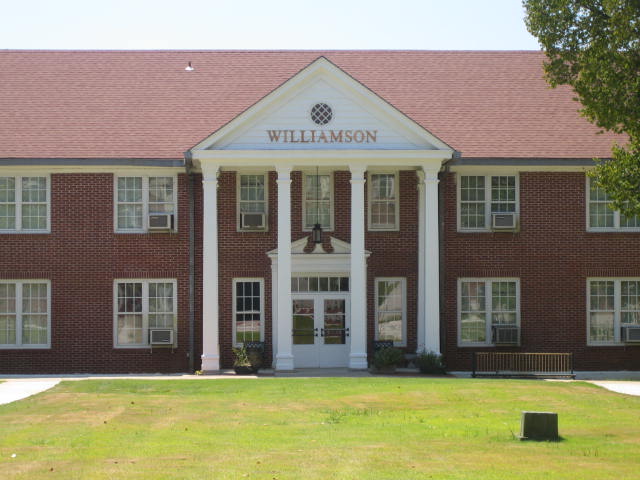
Back in 2008, I made a trip to Russellville, Arkasas to do some genealogy research on my Williamson line, visit cemeteries and what not. One of the things I did was go to the Arkansas Tech University campus. The school held significance because it was built on the land once owned by my Williamson ancestors.
Once on the grounds, I came across Williamson Hall. I went inside to explore:
It was named after Marvin Williamson.
He was the first student enrolled at the school and their band director for 47 years:
Now I thought I knew all of the Williamsons in the area, but Marvin was not on my radar. Did he connect to my family? And how? I know my Williamsons came to the area from Tennessee in 1830. There must have been another group that came from Tennessee at another time. But who and when?
These questions have bugged me for years. Someone even contacted me from the Marvin Williamson line, and I answered back that I didn't know of a connection.
Fast forward to this week. With everyone off doing their own thing for Thanksgiving, I stole some time to work on my own family research. In my files, there is a copy of an unsourced Williamson family history from the 1950's. It was written by Anna "May" Russell (1876-1969), who happens to be my first cousin, three times removed.
In her paper, she described what I already knew: John L. Williamson (my third-great grandfather) and his brother went back to Tennessee, married two sisters and brought them back to Arkansas for their new life. These ladies were distant cousins to the brothers, and they were also named Williamson. Russell's paper further stated that the ladies' brothers also came along on the second trip to Pope County. They got married and had lots of kids, which turned into Williamsons that weren't yet in my files.
Once I started tracking the descendants of these other distant Williamson cousins, things started to fall in place.
Marvin Williamson, the namesake of Williamson Hall, is my second cousin, three times removed. His grandfather and my third-great were the brothers that went back to Tennessee to get the brides. Our common ancestor is John Robert Williamson (1786-1861).
What's this to you? Probably nothing, but to me it's the satisfaction of having answered a question that's been bugging me for years.
Welcome to the family, Marvin Williamson. Maybe I can get my kid into Arkansas Tech as a legacy now.
Tuesday, November 23, 2010
Press Release: NEHGS is now AmericanAncestors.org
NEHGS OFFICIALLY MOVES ITS WEBSITE TO AMERICANANCESTORS.ORG
Boston, MA – November 23, 2010 – Today, The New England Historic Genealogical Society (NEHGS) in Boston bids farewell to its former website www.NewEnglandAncestors.org and officially welcomes AmericanAncestors.org as its new home.
In August, D. Brenton Simons, President and CEO of NEHGS, announced the launch of AmericanAncestors.org. Unlike the former website, AmericanAncestors.org contains all of the Society’s New England and New York content, features, articles, and resources, as well as weekly updates and databases in a variety of regional and ethnic specialties, like mid-Atlantic, Irish, and African American research.
Simons said, “This website marks a transformative experience in our 165-year history, the first genealogical society founded in America. It represents the next major step ahead as we continue to expand our resources.” Simons added, “AmericanAncestors.org is a new, dynamic platform from which we will grow in our position as a leader in American genealogy and as the nation’s largest genealogical society.”
AmericanAncestors.org provides online access to some of the most vital research tools and resources available. Some of the improvements include a new image viewer, faster navigation and search results time, and more unique content. This expanded scope allows greater opportunity for NEHGS to bring unique content to its members as well as the public while establishing new and beneficial collaborations with likeminded non-profit organizations and important commercial entities.
Ryan Woods, Director of Technology, notes a significant advantage of the AmericanAncestors.org website, “The new advanced search form provides all of the necessary search fields to conduct a thorough and specific query, removing the need to navigate across what were previously four hundred different search pages.”
Since the launch of AmericanAncestors.org, there has been constant praise of the new site. Compliments have been given to specific features, such as the advanced search engine, the quality of the images for the Massachusetts Vital Records, the heighted processing speed, and effortless navigation of the website.
Other features that AmericanAncestors.org offers include:
- More exclusive content: more unique, searchable, highly vetted materials for New England, New York, and other regions added weekly
- Enhanced search engine: an all-new, true “master search” that will search across all databases and other web-based content, with faster results and easier navigation
- Personal research profile: a social networking feature for NEHGS members to develop an online profile and input family research information, and even share them with others
- Improved images: a state-of-the-art new image viewer that will provide easier saving, and viewing of images and data
- Timely information: more news on our homepage and an enhanced blog “The Daily Genealogist” will bring our weekly electronic newsletter to the next level with stories and helpful research tips
Moreover, NEHGS is continuing to invite people to sign up for the NEHGS free registration “Guest Registration” program. This program provides anyone with free access to the popular weekly news stories as well as special access to a variety of databases, resources, articles, and other tools to help with their research. More information can be found on the NEHGS website at www.AmericanAncestors.org.
Monday, November 22, 2010
Anatomy of a Military Pension File, Part 26
Previously, I reported on the acquisition of my great-great-great grandfather's military pension file. The documents contained within paint a picture of a man and his family about which I knew very little. I've decided to share this 103-page treasure with you a few pages at a time.
Page 43-44: Document covers with no informational value.
Page 45: Cover for a General Affidavit for the Mexican War
Page 46: Mexican War General Affidavit for Max Baerecke
Text is as follows (handwritten parts in italics):
In the claim of Max Baerecke, late a private of the 15th regiment U.S. Inf.
Personally before me, a notary public in and for aforesaid County and State, Max Baerecke, said claimant, aged 59 years a citizen of the town of Milwaukee, County of Milwaukee, State of Wisconsin, well known to me to be repatable and entitled to credit, and who, being duly sworn, declares in relation to aforesaid case, as follows:
While _____ [line] in the service of the U.S. and in the fall of 1847 while at New Orleans, La., I was attacked by and suffered with yellow fever. I entered the general hospital at that place and was there confined with such disease for about six months and was honorably discharged while at said hospital on account of disability on or about April 15th 1848. Ever p_ _ _e and in consequence of was as a re_ _ _ _(?) of such disease, I have been afflicted with almost total deafness in both ears and my eyesight has been partially destroyed and greatly impaired, so much so that by reason thereof I was and am disabled from pursueing or attending to any vocation or business and cannot earn a subsistence. My said _ _ _ of pension is based upon such injury and disease as aforesaid.
Signed, Max Baerecke
Page 47: more signatures and text related to page 46.
My Max Baerecke is a veteran of two wars, which sometimes complicates things when you're going over a pension file. Page 46 of this particular file is an affidavit regarding Max's service in the Mexican War. Based on his sworn testimony, it looks like he fought his biggest battle against yellow fever.
The description of near complete deafness and blindness sounds very sad indeed. But is it entirely true? I wonder if the description was made to sound a little more horrific than needed for the sake of the pension application.
Either way, this is a nifty little document that I can add to the timeline in the life of my third-great grandfather.
Page 43-44: Document covers with no informational value.
Page 45: Cover for a General Affidavit for the Mexican War
Page 46: Mexican War General Affidavit for Max Baerecke
Text is as follows (handwritten parts in italics):
In the claim of Max Baerecke, late a private of the 15th regiment U.S. Inf.
Personally before me, a notary public in and for aforesaid County and State, Max Baerecke, said claimant, aged 59 years a citizen of the town of Milwaukee, County of Milwaukee, State of Wisconsin, well known to me to be repatable and entitled to credit, and who, being duly sworn, declares in relation to aforesaid case, as follows:
While _____ [line] in the service of the U.S. and in the fall of 1847 while at New Orleans, La., I was attacked by and suffered with yellow fever. I entered the general hospital at that place and was there confined with such disease for about six months and was honorably discharged while at said hospital on account of disability on or about April 15th 1848. Ever p_ _ _e and in consequence of was as a re_ _ _ _(?) of such disease, I have been afflicted with almost total deafness in both ears and my eyesight has been partially destroyed and greatly impaired, so much so that by reason thereof I was and am disabled from pursueing or attending to any vocation or business and cannot earn a subsistence. My said _ _ _ of pension is based upon such injury and disease as aforesaid.
Signed, Max Baerecke
Page 47: more signatures and text related to page 46.
My Max Baerecke is a veteran of two wars, which sometimes complicates things when you're going over a pension file. Page 46 of this particular file is an affidavit regarding Max's service in the Mexican War. Based on his sworn testimony, it looks like he fought his biggest battle against yellow fever.
The description of near complete deafness and blindness sounds very sad indeed. But is it entirely true? I wonder if the description was made to sound a little more horrific than needed for the sake of the pension application.
Either way, this is a nifty little document that I can add to the timeline in the life of my third-great grandfather.
Friday, November 19, 2010
Fun With Search Terms
It's time for another round of "Fun with Search Terms!" People type certain words or phrases into search engines. If the combination is right, my blog shows up in the search results. Sometimes the searches are funny. Sometimes I can provide more information to users, if only they'd comment on my blog. Either way, I enjoy the process. Please note, these searches are anonymous so I don't know who is stumbling on my blog. I just comment in the hope that they find it again.
best genealogy blo
I'm going to ignore the obvious joke and assume you meant "best genealogy blog." If so, then you've come to the right place. Of course, if you don't feel that my blog is the best, consider looking for others at Geneabloggers.com. You can also nominate your favorites for the 2011 Family Tree 40.
genealogy blogging schedule
No help here. I don't believe in a schedule. It's your blog. You can post whenever you want. However, if my "schedule" you are talking about writing posts ahead of time and posting them later, then you want to pre-schedule posts.
we are trees
If you say so.
family history expo photos
At the Family History Expos Facebook page, there is a place where the photo albums for each Expo are listed.
how to get my grandfather's SS-5
I've answered questions like this one before, so that's why this blog keeps coming up in the search results. If your grandfather has passed within the last few decades, he is likely on the Social Security Death Index (SSDI), which you can search for free at GenealogyBank. If you have trouble locating him in the SSDI, try getting his death certificate, which may have his social security number (SSN) on it. Don't panic if you don't have an SSN, if just costs more to order his SS-5. Once you have enough information about your grandfather, you can order copies of SS-5s online here.
john r williamson family tree, arkansas
Yes, I know all about this. Wanna know why? Because I am in that family tree. You must have found what you needed from my blog, because you did not contact me. Sigh....another cousin I will never know. NO FAMILY TREE FOR YOU! Unless you email me, then we're cool.
That's it for now. Have a great weekend everyone!
best genealogy blo
I'm going to ignore the obvious joke and assume you meant "best genealogy blog." If so, then you've come to the right place. Of course, if you don't feel that my blog is the best, consider looking for others at Geneabloggers.com. You can also nominate your favorites for the 2011 Family Tree 40.
genealogy blogging schedule
No help here. I don't believe in a schedule. It's your blog. You can post whenever you want. However, if my "schedule" you are talking about writing posts ahead of time and posting them later, then you want to pre-schedule posts.
we are trees
If you say so.
family history expo photos
At the Family History Expos Facebook page, there is a place where the photo albums for each Expo are listed.
how to get my grandfather's SS-5
I've answered questions like this one before, so that's why this blog keeps coming up in the search results. If your grandfather has passed within the last few decades, he is likely on the Social Security Death Index (SSDI), which you can search for free at GenealogyBank. If you have trouble locating him in the SSDI, try getting his death certificate, which may have his social security number (SSN) on it. Don't panic if you don't have an SSN, if just costs more to order his SS-5. Once you have enough information about your grandfather, you can order copies of SS-5s online here.
john r williamson family tree, arkansas
Yes, I know all about this. Wanna know why? Because I am in that family tree. You must have found what you needed from my blog, because you did not contact me. Sigh....another cousin I will never know. NO FAMILY TREE FOR YOU! Unless you email me, then we're cool.
That's it for now. Have a great weekend everyone!
Thursday, November 18, 2010
Interview with Geni.com
My mom and I have a running joke of sorts. When one of her children (including sons-in-law) gets his or her name in print, she puts her copy of the publication on the coffee table. This started when my brother-in-law was in a surfing magazine. Basically, you can see the back of his head in a photo of a surf resort, but that counts by mom's rules.
For months, that magazine sat alone on the coffee table. Then I was mentioned in Family Tree Magazine's Top 40 Blogs for 2010. My mom bought a copy and I earned a spot on the coffee table. My brother-in-law countered by being interviewed on television. This trumped my magazine mention and his surfer mag got to be on top of my mom's coffee table magazine stack.
Most of the items I've had published have been online or in print magazines that aren't available to the general public (such as the Association of Professional Genealogists Quarterly). This has put me at a disadvantage in the great family media competition, and I have to do more.
This week I bring to the table an interview with Geni.com. I've used this site for a while. It holds my family tree, as well as tagged photos of my ancestors. It is a place my family can go look at their history whenever they feel like it.
The staff of the Geni blog asked to interview me earlier this month and I was honored by the consideration. Here is a link to that interview. Granted, it's not in print, but maybe it's enough to get my magazine back on the top of mom's coffee table.
We shall see...
For months, that magazine sat alone on the coffee table. Then I was mentioned in Family Tree Magazine's Top 40 Blogs for 2010. My mom bought a copy and I earned a spot on the coffee table. My brother-in-law countered by being interviewed on television. This trumped my magazine mention and his surfer mag got to be on top of my mom's coffee table magazine stack.
Most of the items I've had published have been online or in print magazines that aren't available to the general public (such as the Association of Professional Genealogists Quarterly). This has put me at a disadvantage in the great family media competition, and I have to do more.
This week I bring to the table an interview with Geni.com. I've used this site for a while. It holds my family tree, as well as tagged photos of my ancestors. It is a place my family can go look at their history whenever they feel like it.
The staff of the Geni blog asked to interview me earlier this month and I was honored by the consideration. Here is a link to that interview. Granted, it's not in print, but maybe it's enough to get my magazine back on the top of mom's coffee table.
We shall see...
Tuesday, November 16, 2010
Fun and Friends at the Atlanta Family History Expo
This past weekend I was in the Peachtree State for the Atlanta Family History Expo. I had the pleasure of meeting these folks for the first time:
Valerie Craft of the Begin with Craft blog. She brought her sister and mother along as assistants.
Mavis Jones of Georgia Black Crackers and Conversations with My Ancestors blogs. She brought her mother as her assistant.
Drusilla Pair of the Find Your Folks blog. "ProfessorDru," as she's known, was also a guest on this week's African Roots Podcast (#84).
Ginger Smith of the Genealogy by Ginger blog. This was Ginger's first genealogy conference ever. I think we won her over.
Angela Walton-Raji of the African-Native American Genealogy Blog and the voice behind African Roots Podcast.
I also ran into some familiar faces in the genealogy blogging world:
Lisa Alzo, Tonia Kendrick, Thomas MacEntee, Linda McCauley, and DearMyrtle.
It's so fun meeting fellow genealogy bloggers for the first time, and even catching up with good friends. Because we know each other online, the introductions are short. We already know each other, if only through a computer, but that's enough to start the good times rolling.
At the Expo, we had our own set of tables in the exhibit hall. Because they were marked by a sign, people often came by and asked questions about blogs. Some didn't know what a blog was. Some didn't understand the value or appeal of genealogy blogs. Some wanted help starting genealogy blogs.
DearMyrtle and I spent much of both afternoons answering these questions and helping people build their own genealogy blogs. You know what? It was really rewarding.
People are starting to see the value of social media for genealogy. As the great Martha Stewart once said, "It's a good thing."
Valerie Craft of the Begin with Craft blog. She brought her sister and mother along as assistants.
Mavis Jones of Georgia Black Crackers and Conversations with My Ancestors blogs. She brought her mother as her assistant.
Drusilla Pair of the Find Your Folks blog. "ProfessorDru," as she's known, was also a guest on this week's African Roots Podcast (#84).
Ginger Smith of the Genealogy by Ginger blog. This was Ginger's first genealogy conference ever. I think we won her over.
Angela Walton-Raji of the African-Native American Genealogy Blog and the voice behind African Roots Podcast.
I also ran into some familiar faces in the genealogy blogging world:
Lisa Alzo, Tonia Kendrick, Thomas MacEntee, Linda McCauley, and DearMyrtle.
It's so fun meeting fellow genealogy bloggers for the first time, and even catching up with good friends. Because we know each other online, the introductions are short. We already know each other, if only through a computer, but that's enough to start the good times rolling.
At the Expo, we had our own set of tables in the exhibit hall. Because they were marked by a sign, people often came by and asked questions about blogs. Some didn't know what a blog was. Some didn't understand the value or appeal of genealogy blogs. Some wanted help starting genealogy blogs.
DearMyrtle and I spent much of both afternoons answering these questions and helping people build their own genealogy blogs. You know what? It was really rewarding.
People are starting to see the value of social media for genealogy. As the great Martha Stewart once said, "It's a good thing."
Monday, November 15, 2010
The 2011 Family Tree 40: Nominate a Genealogy Blog Now
Nominations are now open for the 2011 Family Tree 40. Categories are slightly different than they were last year. They are as follows:
Local/regional history and genealogy
Heritage groups
Research advice and how-to
Cemeteries
"My Family History"
"Everything" blogs
New blogs
Technology
You can nominate your favorite blogs by using Family Tree Magazine's online submission form.
Special thanks to the panelists who had the tough task of coming up with the categories. There are several blogs I love, yet I don't quite know where they fit. Maybe I'll nominate certain blogs in multiple categories.
Wednesday, November 10, 2010
Changing My Approach to Research Logs
In the series I wrote about going to the Family History Library last month, I mentioned that the experience of having access to so many microfilms at one time allowed me to see how records were organized on the films. This also changed the way I approach my research logs.
Several readers have asked me to elaborate on this. It is difficult to put into words, because my organizational system only makes sense to me. However, I will give it my best shot.
My research logs are mostly focused on events or people. For example, if I'm looking for a marriage date, all the information I have previously covered will be found in the notes for those two people in my database. I use RootsMagic. It has a "to-do list" feature and that's how I use it.
So if I'm searching for a marriage record for John and Mary Smith, the research notes for those people (or that fact in my database) will include the books I have checked, the county offices at which I've inquired, the FHL microfilms I've reviewed, etc, in search of a record. My intent is to know what I've already done so I don't repeat the same searches.
However, my week at the Family History Library gave me lots of time to see lots of records for a given area. Not all the marriage records for a county are on a single roll or concurrent rolls. Sometimes they're mixed up with the tax records, etc. On a given roll, item 1 could be marriages 1900-1904, items 2-3 could be tax rolls 1886-1887, etc.
I never noticed this because at home I can only order a couple film rolls at a time. The ones I've ordered thus far aren't as varied as all the ones I saw in Salt Lake City.
Now I see that my research logs also need to focus on the numbered film rolls, too, not just the event or person. So my notes will tell me that I have already looked at every single frame of film #1234567. That way, I won't order the same film multiple times, once for 1880's tax records, once for 1900's marriage records, etc. I will know I've already seen the whole thing, saving me time and money.
Hopefully I explained this right. Normally I don't comment on my own system or that of others because everyone does it a little differently. There is no right or wrong, just what works for you. And this adjustment is what works for me.
Several readers have asked me to elaborate on this. It is difficult to put into words, because my organizational system only makes sense to me. However, I will give it my best shot.
My research logs are mostly focused on events or people. For example, if I'm looking for a marriage date, all the information I have previously covered will be found in the notes for those two people in my database. I use RootsMagic. It has a "to-do list" feature and that's how I use it.
So if I'm searching for a marriage record for John and Mary Smith, the research notes for those people (or that fact in my database) will include the books I have checked, the county offices at which I've inquired, the FHL microfilms I've reviewed, etc, in search of a record. My intent is to know what I've already done so I don't repeat the same searches.
However, my week at the Family History Library gave me lots of time to see lots of records for a given area. Not all the marriage records for a county are on a single roll or concurrent rolls. Sometimes they're mixed up with the tax records, etc. On a given roll, item 1 could be marriages 1900-1904, items 2-3 could be tax rolls 1886-1887, etc.
I never noticed this because at home I can only order a couple film rolls at a time. The ones I've ordered thus far aren't as varied as all the ones I saw in Salt Lake City.
Now I see that my research logs also need to focus on the numbered film rolls, too, not just the event or person. So my notes will tell me that I have already looked at every single frame of film #1234567. That way, I won't order the same film multiple times, once for 1880's tax records, once for 1900's marriage records, etc. I will know I've already seen the whole thing, saving me time and money.
Hopefully I explained this right. Normally I don't comment on my own system or that of others because everyone does it a little differently. There is no right or wrong, just what works for you. And this adjustment is what works for me.
Tuesday, November 9, 2010
Press Release: Build a Better GEDCOM
Just one more press release today and I promise I'll shut up. This one had me at collaboration. I get the feeling this initiative will change genealogy. Meanwhile, grab some popcorn and watch the action. All are invited to participate, so make your voice heard:
Tuesday Nov 9, 2010. Alexandria, VA. A group of genealogists and programmers have established a workspace called Build A BetterGEDCOM for developing better data exchange standards to facilitate sharing between researchers using a variety of technology platforms, genealogy products and services.
"Genealogy software users are painfully aware that sharing data with other researchers is difficult since the existing GEDCOM (GENealogy Data COMmunication) file transfer script hasn't been updated in 14 years. In the meantime genealogists have incorporated tools with expanded capabilities reflecting changing technology," says Russ Worthington, a genealogy software power user and popular genealogy lecturer.
In developing a wiki site for pulling together genealogy software programmers, website developers and end users, genealogy blogger DearMYRTLE explains "The focus is cooperation. We seek solutions that will enable regular researchers like me to share genealogy with cousins regardless of the genealogy program they've chosen to use. The current GEDCOM file exchange strips out much of my hard work, leaving only some of the data I've typed and attached to each well-documented ancestor. We experience similar problems when uploading and downloading our genealogy data with popular genealogy websites. If all genealogy product developers agree to a BetterGEDCOM format, such problems will be overcome."
The BetterGEDCOM wiki site is open to all, and is located at http://bettergedcom. wikispaces.com.
"BetterGEDCOM will be independent. This means no single entity who has an interest in our work will be the single driving force. Likewise, no work that anyone has done will be the defined starting place or the de facto basis of our work." says Greg Lamberson, the technician who developed initial pages at the BetterGEDCOM wiki. "We also seek to account for language and cultural differences as we develop data standards for recording family history information in text and multi-media formats. Input from BetterGEDCOM participants the world over is a vital component of this initiative."
"BetterGEDCOM will seek ISO recognition or recognition by other international standards bodies," continues Greg. "This has never been done in the genealogical community. This means we will have to be a community effort with participation by a substantial part of the genealogical technology community. Also, unlike previous efforts, having standards actually codified will provide developers a framework to resolve ambiguities, conflicts or other problems that may develop in using the standard as well as a way to correct or amend the standard as needed."
"Indeed everyone seems to be ready for something new," says Greg. "Every person I have talked to agrees that now is the time for action. The BetterGEDCOM project invites all to participate so that we may achieve meaningful results."
BUILD A BetterGEDCOM
A grass roots initiative to improve data exchange among genealogists
Tuesday Nov 9, 2010. Alexandria, VA. A group of genealogists and programmers have established a workspace called Build A BetterGEDCOM for developing better data exchange standards to facilitate sharing between researchers using a variety of technology platforms, genealogy products and services.
"Genealogy software users are painfully aware that sharing data with other researchers is difficult since the existing GEDCOM (GENealogy Data COMmunication) file transfer script hasn't been updated in 14 years. In the meantime genealogists have incorporated tools with expanded capabilities reflecting changing technology," says Russ Worthington, a genealogy software power user and popular genealogy lecturer.
In developing a wiki site for pulling together genealogy software programmers, website developers and end users, genealogy blogger DearMYRTLE explains "The focus is cooperation. We seek solutions that will enable regular researchers like me to share genealogy with cousins regardless of the genealogy program they've chosen to use. The current GEDCOM file exchange strips out much of my hard work, leaving only some of the data I've typed and attached to each well-documented ancestor. We experience similar problems when uploading and downloading our genealogy data with popular genealogy websites. If all genealogy product developers agree to a BetterGEDCOM format, such problems will be overcome."
The BetterGEDCOM wiki site is open to all, and is located at http://bettergedcom.
"BetterGEDCOM will be independent. This means no single entity who has an interest in our work will be the single driving force. Likewise, no work that anyone has done will be the defined starting place or the de facto basis of our work." says Greg Lamberson, the technician who developed initial pages at the BetterGEDCOM wiki. "We also seek to account for language and cultural differences as we develop data standards for recording family history information in text and multi-media formats. Input from BetterGEDCOM participants the world over is a vital component of this initiative."
"BetterGEDCOM will seek ISO recognition or recognition by other international standards bodies," continues Greg. "This has never been done in the genealogical community. This means we will have to be a community effort with participation by a substantial part of the genealogical technology community. Also, unlike previous efforts, having standards actually codified will provide developers a framework to resolve ambiguities, conflicts or other problems that may develop in using the standard as well as a way to correct or amend the standard as needed."
"Indeed everyone seems to be ready for something new," says Greg. "Every person I have talked to agrees that now is the time for action. The BetterGEDCOM project invites all to participate so that we may achieve meaningful results."
Press Release: Memorial Footprints by Timeless Footsteps
Below is a press release I received from Timeless Footsteps in Phoenix. This product sounds interesting. I am pleased to see that they will be at the Atlanta Family History Expo, so I can see them there. You can also follow them on Facebook, Twitter and YouTube. If you have any questions, contact Trevor Hansen of Timless Footsteps, LLC at thansen@timelessfootsteps.com.
Memorial Footprints™ Connect You to Your Ancestors from the Cemetery to Cyberspace
PHOENIX – Nov. 8, 2010 – Timeless Footsteps™ announced today a new way for families to extend family history research from the cemetery to cyberspace.
Memorial Footprints™ are a business card-sized plaque that can be affixed to headstones or other memorials. Leveraging the latest scanning technology, visitors to the memorial can scan the Footprint with a smart phone or other Web-enabled device to access a Web page with additional information on the deceased individual.
“My wife and I were visiting the grave site of an ancestor and looked at the birth and death dates with a dash between them,” said Trevor Hansen, president and founder of Timeless Footsteps. “We commented that we wished we had a way to share all that was really contained in that dash between the dates. That’s what got me thinking about a way to leverage today’s technological capabilities to connect to the Internet from individual memorials.”
Each Memorial Footprint includes a unique Quick Response (QR) code associated with a Web page. Owners of the Footprint can put photos, biographies, other Web links, and associated information on the page, allowing anyone who scans the Footprint to get additional information about the deceased individual.
“In addition to creating an instant connection to ancestors for family members, Footprints allow family history enthusiasts who are researching the same family line to quickly and easily connect,” Hansen said. “Even people who are not avid genealogists can appreciate sharing the memories of their loved ones by placing a Footprint at their grave sites.”
Footprint Web pages include a biography, biographical data and photos of the deceased, as well as connections to social networking pages such as Facebook and Twitter. This information is provided and updated by the owner of the Footprint and can be customized according to their needs. Premium options are available to include a more extensive biography, additional photos, videos, and links to blogs and other websites.
“I love knowing that my mother’s memory is more than just a piece of stone in a cemetery,” said Karen Hunsaker of Phoenix, Arizona. “Anyone who connects to our Footprint page can see the rich life she lived. And by sharing the Web site with others, they can virtually visit her memorial online even if they live hundreds of miles from the cemetery.”
Footprints are available immediately from the Timeless Footsteps website at www.timelessfootsteps.com. Each Footprint comes with a business card-sized plaque, a dedicated Web page, and adhesive to affix the plaque to any memorial surface. Prices start at $49.95. Footprints will also be on display at the Atlanta Family History Expo (November 12-13, 2010) at special prices for exhibit visitors.
About Timeless Footsteps
Timeless Footsteps was founded to help individuals, families and organizations connect to their loved ones. Using the latest scanning technology to connect to the Internet from grave sites and memorials, Timeless Footsteps helps people honor the lives of their loved ones with more than just a dash between birth and death dates.
Friday, November 5, 2010
Family History Library Research Retreat, part 4
See part 1 here, part 2 here, and part 3 here.
So what did I learn from my week at the Family History Expos research retreat at the Family History Library?
1. I viewed 66 microfilm rolls. It costs me $5.50 per film to rent them at my local Family History Center (FHC). Therefore, I viewed $363.00 worth of microfilm during the week.
2. It takes several weeks to order a roll of film and have it delivered to a FHC. You can do the math and see how long it would have taken me to view all of these records at home.
3. I got a chance to see how records are organized on the rolls. Many types of records can be on one roll. The way I currently log my research will be improved because of this trip. I see now that I can record this information better, and I will.
4. The flash drive was the best way for me to retrieve records. I took home 329 images. That's a lot of work for me to record and add to my database!
All genealogists should experience the Family History Library at some point. All of these records are at your fingertips:
And all you have to do is go get them:
Family History Expos hosts research retreats in April and October of each year. I had a great time and would be happy to answer any questions about the event. Feel free to email me at the address provided i the right column of this blog.
[Please see my Disclosures page for information on my connection to Family History Expos. --Amy]
So what did I learn from my week at the Family History Expos research retreat at the Family History Library?
1. I viewed 66 microfilm rolls. It costs me $5.50 per film to rent them at my local Family History Center (FHC). Therefore, I viewed $363.00 worth of microfilm during the week.
2. It takes several weeks to order a roll of film and have it delivered to a FHC. You can do the math and see how long it would have taken me to view all of these records at home.
3. I got a chance to see how records are organized on the rolls. Many types of records can be on one roll. The way I currently log my research will be improved because of this trip. I see now that I can record this information better, and I will.
4. The flash drive was the best way for me to retrieve records. I took home 329 images. That's a lot of work for me to record and add to my database!
All genealogists should experience the Family History Library at some point. All of these records are at your fingertips:
And all you have to do is go get them:
Family History Expos hosts research retreats in April and October of each year. I had a great time and would be happy to answer any questions about the event. Feel free to email me at the address provided i the right column of this blog.
[Please see my Disclosures page for information on my connection to Family History Expos. --Amy]
Thursday, November 4, 2010
Family History Library Research Retreat, part 3
See part 1 here and part 2 here.
As part of their Family History Library research retreats, Family History Expos provides access to professional genealogists to guide attendees with their research as well as provide advice and instruction. Because I had a good idea of the information I needed, I didn't get to take advantage of that perk as much as others did.
On Friday, I did inquire about the resources available for Indian Territory. My ancestors lived in Oklahoma before it was Oklahoma. Who has those records and how can I get them? My biggest problem is that I don't know what I don't know about these resources. The expert provided me some great leads. I took home a lot of information that will benefit me for years to come.
I also inquired about a German marriage record at the Europe reference desk at the Family History Library. A very knowledgeable woman told me the FHL did not carry the marriage record because it was too recent. She showed me where to write for it in Germany. She also told me exactly what to write in order to get the best response. I was deeply grateful for her advice. She saved me time and increased my chances of getting an answer.
Saturday, I spent the morning in the U.S. book section. I spent the afternoon gathering Pope County, Arkansas tax records from the late 1800's.
In the evening, Family History Expos president Holly Hansen hosted a little party for the attendees. We talked about our research success stories and viewed a slide show of the week's events:
There was even a cake! It was so good that people started cutting pieces before I could get a picture of the whole thing:
I spent Saturday evening reflecting on all I had accomplished. The short answer was "a lot." The long answer requires another post.
On to part 4 here.
[Please see my Disclosures page for information on my connection to Family History Expos. --Amy]
As part of their Family History Library research retreats, Family History Expos provides access to professional genealogists to guide attendees with their research as well as provide advice and instruction. Because I had a good idea of the information I needed, I didn't get to take advantage of that perk as much as others did.
On Friday, I did inquire about the resources available for Indian Territory. My ancestors lived in Oklahoma before it was Oklahoma. Who has those records and how can I get them? My biggest problem is that I don't know what I don't know about these resources. The expert provided me some great leads. I took home a lot of information that will benefit me for years to come.
I also inquired about a German marriage record at the Europe reference desk at the Family History Library. A very knowledgeable woman told me the FHL did not carry the marriage record because it was too recent. She showed me where to write for it in Germany. She also told me exactly what to write in order to get the best response. I was deeply grateful for her advice. She saved me time and increased my chances of getting an answer.
Saturday, I spent the morning in the U.S. book section. I spent the afternoon gathering Pope County, Arkansas tax records from the late 1800's.
In the evening, Family History Expos president Holly Hansen hosted a little party for the attendees. We talked about our research success stories and viewed a slide show of the week's events:
There was even a cake! It was so good that people started cutting pieces before I could get a picture of the whole thing:
I spent Saturday evening reflecting on all I had accomplished. The short answer was "a lot." The long answer requires another post.
On to part 4 here.
[Please see my Disclosures page for information on my connection to Family History Expos. --Amy]
Wednesday, November 3, 2010
Rock the APG Vote
Yesterday I voted. No, not in the U.S. election. I did that days ago. I voted in the Association of Professional Genealogists election.
I looked at the ballot and realized I knew several of the candidates personally, all of whom I met first through my blog, Facebook or Twitter. Eventually these online acquaintances became real-life friends.
I carefully read each candidate's bio and information. Then I voted on the issue that is most important to me in this election: social media.
Why social media? Because it is an important tool in research and professional networking. Also, APG has been slow to adopt social media into their fold, and I want to see that change. This is the only professional research organization I know of that bans the use of social media at certain events. Librarians don't. Independent researchers don't. Why do genealogists? The only reason I can think of is that the full value of social media is not understood by those in the position to make the decisions.
Several months ago, I emailed the organization and offered my assistance in getting the group's social media presence off the ground, using these tools to reach out, and getting those members who are online involved. My offer was not accepted. This isn't a complaint. I'm just pointing it out so you know I did try to *be* the change I wanted to see.
So on my ballot, I didn't put much consideration into the letters behind the candidates' names (CG, AG, ABCDEFG). I took slight consideration into the candidates' participation in the email discussion lists, (this is why it's bad to lose your cool online, folks). But really I cast my votes based on the online presence of each of the candidates and determined which ones would, in my opinion, be best qualified to help APG get to the next social media step.
And that's how I voted.
If you're a member of the Association of Professional Genealogists, I encourage you to determine the issues in professional genealogy that are most important to you and vote. Hurry though, because the polls close November 5. You will find all the information you need in the Members Only section. This is your group and you pay to be a part of it. It's a great resource, and your participation will make it better.
Family History Library Research Retreat, part 2
See part 1 here.
With my first full day of FHL research behind me, I returned each morning with a plan. The second day, I sought and located marriage records for my Lenertz line in Blue Earth county, Minnesota. There wasn't much groundbreaking research going on. I knew what I needed and I found it. Most of the records were to help me add more information to my 100% cited family tree.

One of the more interesting things I found was a record of physicians in Stephens County, Oklahoma. My great-grandfather, his uncle and a cousin were all included there. I also found a ton of marriage records. I knew the dates, I just needed the records for them to be legit in the eyes of the genealogy police.
I spent most of my week at left-handed reader 6-L on the United States floor. It was usually quiet in my row because, well...it's a right-handed world out there:
What makes it left-handed? The handle is on the left. Really, I could deal with either handle, but I needed the lefty writing space for mymess research.
My biggest challenge of the week was the search for and location of probate records for my 4th great-grandfather John McElroy Bourland. I first checked the indexes and dutifully wrote down the pages where I should find the records. However, the pages didn't correspond. Finally, after a page-by-page inspection of the film, I found an estate list for Bourland and then finally all of the related records. This entire process took six hours, plus another to acquire copies of all the documents. Persistence paid off.
On to part 3 here.
[Please see my Disclosures page for information on my connection to Family History Expos. --Amy]
With my first full day of FHL research behind me, I returned each morning with a plan. The second day, I sought and located marriage records for my Lenertz line in Blue Earth county, Minnesota. There wasn't much groundbreaking research going on. I knew what I needed and I found it. Most of the records were to help me add more information to my 100% cited family tree.
One of the more interesting things I found was a record of physicians in Stephens County, Oklahoma. My great-grandfather, his uncle and a cousin were all included there. I also found a ton of marriage records. I knew the dates, I just needed the records for them to be legit in the eyes of the genealogy police.
I spent most of my week at left-handed reader 6-L on the United States floor. It was usually quiet in my row because, well...it's a right-handed world out there:
What makes it left-handed? The handle is on the left. Really, I could deal with either handle, but I needed the lefty writing space for my
My biggest challenge of the week was the search for and location of probate records for my 4th great-grandfather John McElroy Bourland. I first checked the indexes and dutifully wrote down the pages where I should find the records. However, the pages didn't correspond. Finally, after a page-by-page inspection of the film, I found an estate list for Bourland and then finally all of the related records. This entire process took six hours, plus another to acquire copies of all the documents. Persistence paid off.
On to part 3 here.
[Please see my Disclosures page for information on my connection to Family History Expos. --Amy]
Tuesday, November 2, 2010
Family History Library Research Retreat, part 1
Last week, I had the fortune of attending the Family History Expos research retreat at the Family History Library.* The event included 5 full days of research at the library, morning / evening classes and access to genealogy professionals. I thought it might be nice to describe my week so you can see what a research retreat entails.
I arrived in Salt Lake City on Monday. That evening, Family History Expos held a pizza/salad dinner for all of the research retreat attendees. We got to meet each other and the professionals that would be helping us with our research.
Tuesday morning came quickly. I woke up to this view after an overnight dusting of snow:
We had a morning class about resources in the Family History Library. For those that had never been to the Family History Library, there was a tour of the floors, their collections and more. Then it was time to leave the nest and start researching!
I came with a plan and a shopping list of things I wanted to research. I started with my great-grandparents' marriage. I only had a date range (1915-1916) and an area (counties surrounding Lehigh, PA). I searched all the available records with lightning speed. Once I was done with one county, I retrieved the film of another. If I had done this from home, I'd be ordering the films one or two at a time. It would have taken months to get this far!
My first day at the Family History Library didn't bring any great discoveries in Pennsylvania, but that's part of the research process. I omitted several counties where the marriage did not take place. It's not an answer, but it's progress.
In the afternoon, I researched my Smith line, including my third great-grandparents with the oh-so-uncommon monikers Joseph and Mary Smith. I figured the FHL was the best place to do it, since I would need quick access to lots of records.
I found several Smith deaths in LeSueur County, Minnesota, including a record for Joseph Smith. He apparently died in 1903 (in his 70's) of an infection incurred from an injury seven days prior. What a way to go. The record also gave me the names of his parents! Wanna know who my fourth great-grandparents are? John and Elizabeth Smith. Why can't I get an Ebeneezer in this line?
See part 2 here.
[*Please see my Disclosures page for information on my connection to Family History Expos. --Amy]
I arrived in Salt Lake City on Monday. That evening, Family History Expos held a pizza/salad dinner for all of the research retreat attendees. We got to meet each other and the professionals that would be helping us with our research.
Tuesday morning came quickly. I woke up to this view after an overnight dusting of snow:
We had a morning class about resources in the Family History Library. For those that had never been to the Family History Library, there was a tour of the floors, their collections and more. Then it was time to leave the nest and start researching!
I came with a plan and a shopping list of things I wanted to research. I started with my great-grandparents' marriage. I only had a date range (1915-1916) and an area (counties surrounding Lehigh, PA). I searched all the available records with lightning speed. Once I was done with one county, I retrieved the film of another. If I had done this from home, I'd be ordering the films one or two at a time. It would have taken months to get this far!
My first day at the Family History Library didn't bring any great discoveries in Pennsylvania, but that's part of the research process. I omitted several counties where the marriage did not take place. It's not an answer, but it's progress.
In the afternoon, I researched my Smith line, including my third great-grandparents with the oh-so-uncommon monikers Joseph and Mary Smith. I figured the FHL was the best place to do it, since I would need quick access to lots of records.
I found several Smith deaths in LeSueur County, Minnesota, including a record for Joseph Smith. He apparently died in 1903 (in his 70's) of an infection incurred from an injury seven days prior. What a way to go. The record also gave me the names of his parents! Wanna know who my fourth great-grandparents are? John and Elizabeth Smith. Why can't I get an Ebeneezer in this line?
See part 2 here.
[*Please see my Disclosures page for information on my connection to Family History Expos. --Amy]
Monday, November 1, 2010
The Advent Calendar of Christmas Memories
Happy November! You know what that means...it's time to prepare for the Advent Calendar of Christmas Memories blog series. Below is the press release I received and all of the information you need to participate. It's great fun to read everyone's posts, so please join the fun!
THE ADVENT CALENDAR OF CHRISTMAS MEMORIES RETURNS!
Capture Your Family’s Memories of Christmas 24 Ways in 24 Days
November 1, 2010 – Chicago, IL. GeneaBloggers – the genealogy community’s resource for blogging announces the return of the Advent Calendar of Christmas Memories beginning December 1, 2010.
What started as a bi-annual event December 2007 as a way for genealogy bloggers to capture and document the memories of family holiday traditions has now grown into an annual event with its own blog. Visit the Advent Calendar of Christmas Memories at http://adventcalendar.geneabloggers.com and learn how you can participate in this unique online genealogy event.
Beginning December 1, 2010, each day will present a specific blogging prompt such as Christmas Cookies and bloggers will be asked to write about their memories related to the theme and their family history. A new prompt will appear each day through December 24, 2010.
Bloggers who have participated in the past can join in the fun again by either repeating their posts from previous years or creating new posts. Besides creating an on-line journal of Christmas memories, some bloggers have even gone on to create books of their previous Advent Calendar posts to share with family and friends.
Don’t’ forget to check out the list of blogging prompts and get started on capturing your childhood Christmas memories today!
Follow the Advent Calendar of Christmas Memories on Facebook (http://www.facebook.com/pages/Advent-Calendar-of-Christmas-Memories/159472580759391), Twitter (http://www.twitter.com/adventcal) and on our blog at http://adventcalendar.geneabloggers.com.
Subscribe to:
Posts (Atom)