Here are some news stories from around the genealogy world that may be of interest to you:
The FGS News Conference Blog is asking members to share ways that their societies are using technology. This information will be collected and shared with other societies during the 2011 conference in Springfield, IL. If you have a novel idea or story of success, share it! Details and contact information are here.
A.C. Ivory of Find My Ancestor has introduced a new newsletter to which you can subscribe. A.C. is one of the best resources for information mobile apps, Macs, and general use of technology in genealogy.
The Middle Peninsula African-American Genealogical and Historical Society is featuring some of the RootsTech videos at their website. Included in the list is Curt Witcher's "The Changing Face of Genealogy," which should be required viewing for all genealogists and societies. This isn't a complete list of the videos, but you can see these few online here.
Relative Roots has announced their March webinar schedule. See the list here.
A.C. Ivory of Find My Ancestor gets double billing today. He's released a video on how to make your Blogger blog mobile friendly. He promises to do the same for WordPress soon.
That's it for today. Go forth and be awesome.
Monday, February 28, 2011


Book Review: Life in Civil War America

Life in Civil War America is a completely revised edition of Everyday Life in the Civil War, which was first published in 1999. Author Michael Varhola has added substantially to the 2011 edition including two new chapters and other enhancements to make this a definitive handbook for the study of the Civil War.
The book is intended to give readers a broad-based view of everyday life before, during and after the Civil War. The various elements of the era are divided into thirteen chapters covering topics such as housing, education, slang, entertainment, religion, dress, wages, shortages, food, technology and more.
Five appendixes bring up the rear of the book, including a section on Civil War photography by Maureen A. Taylor. In her piece, Taylor shares how photography was used to document the War and how images impacted those involved. Other appendixes cover the Civil War timeline, bibliography, suggested readings and resources, songs and poetry.
Genealogists will find the Introduction helpful and handy. It describes the steps to determining Civil War ancestors (including those who assisted in other areas besides battle), and ways to locate their records. General and location-specific website addresses are included in this section.
Life in Civil War America is a history book geared toward the general-interest audience. Do not expect to find your ancestor’s name in here, nor details on specific battles. However, you will get a description of the period and an introductory Civil War military lesson. Varhola’s book is ideal for writers, students (8th-college), genealogists and history buffs looking for an all-encompassing work that explains the basics of a complex era in United States history.
Friday, February 25, 2011
Genealogy News Bits for February 25, 2011
Here are a few news stories I've gathered today that may be of interest to you:
RootsMagic has announced their free online classes for March.
Tip of the cap to DearMYRTLE for her hand in setting up GeneaWebinars.com. There are so many great webinars out there, but it's hard to keep track of them. This blog includes a calendar so you never have to miss an online genealogy education opportunity again. Thanks, Myrt!
If you watch the Who Do You Think You Are? television show (or not) on tonight, don't forget to tune into Geneabloggers Radio after the show. There's even a chat room for those who are listening. It's great fun!
Guess that's it for today. Go forth and be awesome.
RootsMagic has announced their free online classes for March.
Tip of the cap to DearMYRTLE for her hand in setting up GeneaWebinars.com. There are so many great webinars out there, but it's hard to keep track of them. This blog includes a calendar so you never have to miss an online genealogy education opportunity again. Thanks, Myrt!
If you watch the Who Do You Think You Are? television show (or not) on tonight, don't forget to tune into Geneabloggers Radio after the show. There's even a chat room for those who are listening. It's great fun!
Guess that's it for today. Go forth and be awesome.
A Stolen Genealogy Moment

Beignet on the banks of the Mississippi, New Orleans, Feb. 2011
Yesterday, my son and I had a lot of conversation time together as we waited an hour to be seen by his doctor. My son isn't much of a talker about his life, except when it comes to railroad crossing signals. However, we had nothing but time in that little room so he started telling me about school and how he was learning about the Civil War.
Like a good little genealogist, I told him about his own ancestors that were part of this event. He has at least four 4th-great grandfathers who were in the Civil War, two on each side. I made sure he knew one was at Gettysburg (and a book was written about his regiment), and another died in battle in Louisiana.

Battle of Calcasieu Pass Civil War Memorial
Cameron Parish Courthouse, Louisiana
Includes R. M. Jones, my 3rd great grandfather
My son seemed a little more interested than I'd expect a boy his age to be. He's getting a public school education in Texas, while I had one in California. The Civil War unit is/was presented differently to us, because we grew up in different parts of the country.
I don't think my son will share with his teacher the history he knows about his own ancestors and their participation in the Civil War. I'm just glad he knows they were there, which is more than I did at his age.
Thursday, February 24, 2011
News Bits for February 24, 2011
Here are a few genealogy related news stories I picked up today:
Per GeneaBloggers.com, the NBC show "Who Do You Think You Are?" was renewed for a third season. Given the trigger happy tendencies of networks these days, this if kind of a big deal. Plus it gives me something to watch on Fridays. Read about it here.
Thomas MacEntee and Legacy Family Tree Webinars are hosting a free webinar. "Backing Up Your Genealogy Data" will be on March 23 at 2pm EST/11a PST. More details and a sign-up link can be found here.
FamilySearch helping preserve and provide access to African records and histories. FamilySearch shared the record collections they have in this area, as well as what will be available in the future.
Guess that's it for today. Go forth and be awesome.
Per GeneaBloggers.com, the NBC show "Who Do You Think You Are?" was renewed for a third season. Given the trigger happy tendencies of networks these days, this if kind of a big deal. Plus it gives me something to watch on Fridays. Read about it here.
Thomas MacEntee and Legacy Family Tree Webinars are hosting a free webinar. "Backing Up Your Genealogy Data" will be on March 23 at 2pm EST/11a PST. More details and a sign-up link can be found here.
FamilySearch helping preserve and provide access to African records and histories. FamilySearch shared the record collections they have in this area, as well as what will be available in the future.
Guess that's it for today. Go forth and be awesome.
Wednesday, February 23, 2011

Tuesday, February 22, 2011
News Bits for February 22, 2011
Here are the bits o' news I've collected recently that may be of interest to you:
The Southern California Genealogical Society announced their Jamboree Extension Series for 2011. There are many webinars you can attend from home. See the schedule and list of speakers here.
FGS announced their Sandra H. Leubking Memorial. See details on how you can support a good cause and honor Sandra's memory here.
In case you missed RootsTech or can't get enough of it, here's a FamilySearch wiki page on this year's event. If you attended, feel free to contribute.
That's it for today. Go forth and be awesome.
The Southern California Genealogical Society announced their Jamboree Extension Series for 2011. There are many webinars you can attend from home. See the schedule and list of speakers here.
FGS announced their Sandra H. Leubking Memorial. See details on how you can support a good cause and honor Sandra's memory here.
In case you missed RootsTech or can't get enough of it, here's a FamilySearch wiki page on this year's event. If you attended, feel free to contribute.
That's it for today. Go forth and be awesome.
Win a copy of RootsMagic 4 and the book!

At RootsTech, Bruce Buzbee gave the official bloggers copies of RootsMagic and the accompanying Getting the Most Out of RootsMagic 4 book to do with at they see fit. This little swag was billed as a virtual door prize, meant for folks who watched RootsTech unfold from home.
So if you weren't able to come to Salt Lake City to join the fun, RootsMagic's generosity has allowed me to bring the fun to you:
Win a copy of RootsMagic 4 software and the Getting the Most Out of RootsMagic 4 book!

Petey the feline spokesmodel not included
The fairest way I can think of to give everyone an equal chance is a random drawing. Send me an email at [Redacted. Contest over.] with RootsMagic in the subject line. You can enter now through 11:59PM Central Time on Tuesday, March 1, 2011. Each email will be numbered in the order in which they landed in the email box. On Wednesday, March 2, I will randomly draw and announce the winner.
This little event is open to blog readers in the U.S. and Canada only. Sorry, but postage rates make it so.
Anyone who does not already own a copy of RootsMagic 4 is eligible. Owners of earlier editions of RootsMagic are welcome to enter the drawing, as RootsMagic 4 is completely different than what you own.
Genealogy bloggers, feel free to let your readers know about this drawing. It's all about spreading some genealogy love.
Guess that's it. Good luck to everyone!
Monday, February 21, 2011
News Bits for February 21, 2011
As promised, here are some of the news stories I've collected today that may be of interest to you.
FGS has put out it's call for papers for the 2012 conference. Details and guidelines here.
Are you a blogger who will be at Jamboree? Geneabloggers wants to know so answer this quick survey. I suspect this is a preliminary head count for a possible social event so let your voice be heard.
Remember the unconferencing session on Technology and Genealogy Societies I attended at RootsTech? The notes on the session have been published here. Use them as you wish and share them with your societies.
Guess that's it for today. Now go forth and be awesome.
FGS has put out it's call for papers for the 2012 conference. Details and guidelines here.
Are you a blogger who will be at Jamboree? Geneabloggers wants to know so answer this quick survey. I suspect this is a preliminary head count for a possible social event so let your voice be heard.
Remember the unconferencing session on Technology and Genealogy Societies I attended at RootsTech? The notes on the session have been published here. Use them as you wish and share them with your societies.
Guess that's it for today. Now go forth and be awesome.
Genealogy Societies: What Keeps You Coming Back for More?
Earlier this year, I asked what makes you join a genealogy society. I had just dropped some memberships and renewed others and I wanted to know your criteria. I have another set of questions for you on what makes you stay in any given group:
What do you like about the genealogy societies to which you belong? What makes you stay a member and renew each year?
Please comment if you can. I am very interested what you have to say on the subject.
Here's my answer on what keeps me coming back to a genealogy society year after year:
A active online presence. I'm a distance member at most of the societies to which I belong. Seeing the group exist and evolve online allows me to connect from afar. It also allows me to see where my money is going. I want to comment on their blogs and Facebook pages. I've been a member of several societies where my only contact with the group was through a mailbox. I prefer more interaction, and tend to gravitate toward societies that are willing to reach out in different ways.
A deep commitment to preserving local/regional history, or a genuine love of genealogy. I love groups that maintain a tight connection to the past. I belong to one society that is too small to have their own library, but they are in tight with the local library and have dedicated themselves to making the research room a must-see. I have no problem paying my dues to this group every year because I can see where my money is going. They have a clear mission and I support it. I also belong to a group that has few local resources, but they sure have a good time talking about genealogy. They make it fun, and I'm happy to be a member of fun.
A variety in programming and social meetings. The monthly in-person gathering with a speaker is nice, but I also enjoy less formal meetups just to talk about genealogy. I like being a part of societies that have interest groups, webinars, online chats and more opportunities to socialize.
Resourcefulness. Societies with vision get my renewals. I like knowing my membership dollars go toward groups with creative approaches to volunteer utilization, marketing, forward thinking and a willingness to try new things. This is how you grow and I enjoy being a part of groups that understand that.
In looking at these answers, I realize that I haven't mentioned society magazines, quarterlies and journals. While these are nice, and I read them (eventually), they are not the reason I belong to any given society. I keep thinking of all the time and money put into these publications, and here it's not even a factor in how I choose my genealogy society memberships. I wonder if others feel this way, or is it just me?
What about databases? The societies to which I belong either don't have them, or my research does not pertain to the ones they have. As of now, databases don't do it for me in terms of membership preferences, but I expect that to change as I join new groups.
Also, I realize that the key themes in my answers are interaction and socialization with a heavy dose of online contact. These are not the usual answers one would expect, so I'm wondering if I am off base in my preferences or not and that's how this blog post came to be.
So what about you? What are your societies doing right? I want to know what motivates you to join and stay in any given group.
Sunday, February 20, 2011
Collin County Seminar with Lloyd Bockstruck
The Collin County Genealogical Society is hosting an-all day seminar on April 30, 2011 at the South Fork Hotel in Plano, Texas.
Legendary genealogy speaker Lloyd Bocksrtuck will cover these topics:
For more information on this event, including registration details, please see the CCGS flyer.
Legendary genealogy speaker Lloyd Bocksrtuck will cover these topics:
- Migrations, 1607-1850
- Illegitimacy
- The War of 1812
- Genealogical Research in South Carolina
For more information on this event, including registration details, please see the CCGS flyer.
Saturday, February 19, 2011
Generation Maps $300 Contest. Do you have the magic words?

If you produce the phrase that pays, you will win a $300 Generation Maps credit good on any of their fabulous products. So brainstorm like crazy, then go to this Generation Maps contest page to submit your brilliance.
Just know that my entry, I CAN HAS CHARTS, is going to be the winner, so congrats on second place.
Contest ends April 4, 2011. Good luck!
Friday, February 18, 2011
GeneaPress makes my life easier

In the days before RootsTech, I decided I was going to write a post about press releases and my approach to them. It was swimming in the editorial calendar in my head and I planned to discuss it on this blog when I returned home.
Here's the deal: I get a lot of press releases in my email box. I post ones that I like or think my readers will like. I do not post if I have seen other bloggers have already posted the same thing. As more and more press releases are issued, I have to decide what goes up and what stays down. I want everyone to be informed, yet I don't want this to be one of those blogs that publishes nothing but announcements.
So the plan was to write about my perception of press releases here in this little post since I felt a little overloaded in that department. However, the issue was bothering several bloggers at the conference. As an approach to the situation, Thomas MacEntee created GeneaPress.com as a collection spot for the latest press releases in the genealogy field. He flipped the switch to ON Wednesday, and I thought you might be interested in it.
Whew! That saves me a bunch of time on how to explain there's a lotta press releases out there, and I can't publish them all. Now I don't have to! And you can see all the latest news by subscribing to the site.
Here's my take on press releases and this blog from here on out (until I change my mind):
I will still publish some press releases. There are people and products in which I really believe, and I will share that news as I see fit.
In order to share the love without being labeled on of those blogs that lacks real content, I may occasionally gather up some links and put them in a single short-but-sweet news post.
If you have a press release or two (or eleventy as some companies do) feel free to send them to me, but I make no promises of publication. Also, don't send email attachments unless we've shared a meal together. If you use the line "I think you're blog readers might like this," it means you haven't read my blog. My readers like free stuff and bacon. Oh wait, that's me.
Guess that's it for my talk on press releases. Meeting adjourned.
Thursday, February 17, 2011
Why RootsTech is the Bees Knees

All the RootsTech recaps are done. I hope you liked my play-by-play action. There's just a little bit more to say about the event. Here are a few reasons why I enjoyed RootsTech and felt it stood out from other national events of similar size:
The conference and all the sessions looked forward.
No matter the topic, all sessions and speakers' messages had a common element. They all had vision and considered the future, even when talking about the past. This is the attitude I want in the events for which I pay to attend, and I will look for that element in future conferences.
The environment encouraged the use of electronics and social media tools.
I am SO OVER events that dictate what I can and can't use to take notes and push content. I really appreciated that the RootsTech crew wanted me to use my netbook and phone. I took notes. I communicated with others at home. I was happy. In the future, I will seek out events that desire and accept their attendees to learn in all different ways, including with electronic devices.
RootsTech planners explored other session formats including unconferencing and ample use of the panel format.
I've really come to enjoy panel discussions and group collaborations. Speakers and lectures are great, but I want to hear more information from more people. Other fields have been doing unconferencing for years. Kudos to RootsTech for introducing it to the genealogy world. I hope to attend more of these sessions at Rootstech 2.0 in 2012.
I felt like FamilySearch was genuinely happy to have me there.
FamilySearch staff were always available and ready to help me. They provided extensive information for me to post on my blog, and really sincerely wanted my feedback. I can't say that I've felt that way at most of the major genealogy events I've attended. In the future, I will gravitate toward events that have the same type of positive vibe that was generated at RootsTech.
There was a variety of keynote speakers.
Did you notice that some of the best information came from non-genealogy speakers? I must tip my hat to the RootsTech planners for casting a wider net and reeling in some of the bigger names in the information field. Jay Verkler understands that genealogy is a lane on the information highway. It's time to get moving in the same technological direction as the other fields on the road, and RootsTech exists to see that it happens.
The vibe had no right or wrong, but instead a common goal.
At RootsTech, there were no citation police, no technology police, no ad nauseam email discussions on the beating of dead horses. Rather, it was a joining together event to discuss what we do and see how we can do it better. I dig this groove and will be looking for other events that share the same philosophy.
Keep the rock music.
This is so silly, but I heard a handful of complaints from folks that didn't like the music used to introduce keynote speakers. Really? Really. That's your main complaint about the conference? So I feel I must counter the crankypants faction and say I hope they keep the music and play more of it.
These are my people.
I don't feel inclined to say ABC and XYZ conferences should be more like RootsTech. Every event has its own personality and customer base. That's what makes them special. What I learned last week however, was that I have a preference for events like this here RootsTech shin dig. In the future, this is where I and my genealogy dollars will be. If your family history event has the same forward-thinking vibe, then maybe I'll come to your party, too, or not. There's a lot of choices out there now.
RootsTech 2011 was a game changer, and I feel blessed to have a front-row seat. It's a great time to be a genealogist.
Wednesday, February 16, 2011
2011 RootsTech Update 7
The third and final day of RootsTech came way too fast. Once again, I was up early. By the time the opening session came around, I was wide awake and ready to go.

Brewster Kahle of Internet Archive fame, gave a great and informative talk on his site, information access and the size of the Internet. There's no way I could do the measurements justice, so be sure to watch the video when it comes out. Based on the conversation happening on Twitter during the session, it was well-received by those watching at home as well.
Some commented that they thought Internet Archive and the Wayback Machine were neat tools. They've been around a long time. I keep saying that some of the best genealogy tools aren't really part of genealogy. That's how my 52 Weeks to Better Genealogy Series was born. It was part of my evil plan to get people playing in the sandbox. I give high praise to the RootsTech planners for bringing in Kahle as a speaker and showing just how relevant the bigger information landscape is to the smaller genealogy world.
In the late morning, I went to talk to more vendors including RootsMagic. I asked how the crowd of this conference was different from others and was told that the questions they asked were different. They were more technical. I think this conference drew people who weren't afraid of the word "tech" in the name. They may not be tech whizzes, but they wanted to learn.
Then I again had lunch with the ladies, Kerry and Missy. We talked some more about the genealogy field and our place in it. We talked about our respective backgrounds in HR (Kerry) and libraries (Missy and me). Genealogy is going where those fields have been in terms of incorporating technology, so we were joking about being from the future. We really did have a good time at lunch, though my description makes it sound lame. All you have to know is this: Blue Lemon = yum.
After our meal, we went to the virtual presentations panel moderated by Thomas MacEntee. I swear I wasn't stalking the guy. He just happened to present on topics in which I was interested. Plus, I love the panel format. This session had participants in-person and on the phone. Basically, I learned that virtual presentations aren't as difficult to produce as you may think. This session was live broadcast be FamilySearch, so hopefully it will be available on video. I think genealogy society officers should view it and consider virtual presentations for their own groups.
We stayed on for the closing session. This made me sad, though all good things must come to an end. Jay Verkler called all the behind-the-scenes RootsTech planners on stage. The audience gave them a sincere standing ovation, which chocked Verkler up a bit. It was a nice moment.
In the evening, I had the pleasure of attending an informal dinner at the home of A.C. Ivory and his family. I learned that A.C.'s parents call him "Ace" (aww....) and they have a cat that knocks on the door when it wants in. I learned that his parents make an amazing dinner and are wonderful people. I was able to talk with many of my friends that I don't get to see much because they're always so busy during conferences. Mostly on the evening, I learned that I'm really lucky to have such wonderful friends.


(brightsolid was a big RootsTech sponsor,
so I'm showing them some love.)
so I'm showing them some love.)
Brewster Kahle of Internet Archive fame, gave a great and informative talk on his site, information access and the size of the Internet. There's no way I could do the measurements justice, so be sure to watch the video when it comes out. Based on the conversation happening on Twitter during the session, it was well-received by those watching at home as well.
Some commented that they thought Internet Archive and the Wayback Machine were neat tools. They've been around a long time. I keep saying that some of the best genealogy tools aren't really part of genealogy. That's how my 52 Weeks to Better Genealogy Series was born. It was part of my evil plan to get people playing in the sandbox. I give high praise to the RootsTech planners for bringing in Kahle as a speaker and showing just how relevant the bigger information landscape is to the smaller genealogy world.
In the late morning, I went to talk to more vendors including RootsMagic. I asked how the crowd of this conference was different from others and was told that the questions they asked were different. They were more technical. I think this conference drew people who weren't afraid of the word "tech" in the name. They may not be tech whizzes, but they wanted to learn.
Then I again had lunch with the ladies, Kerry and Missy. We talked some more about the genealogy field and our place in it. We talked about our respective backgrounds in HR (Kerry) and libraries (Missy and me). Genealogy is going where those fields have been in terms of incorporating technology, so we were joking about being from the future. We really did have a good time at lunch, though my description makes it sound lame. All you have to know is this: Blue Lemon = yum.
After our meal, we went to the virtual presentations panel moderated by Thomas MacEntee. I swear I wasn't stalking the guy. He just happened to present on topics in which I was interested. Plus, I love the panel format. This session had participants in-person and on the phone. Basically, I learned that virtual presentations aren't as difficult to produce as you may think. This session was live broadcast be FamilySearch, so hopefully it will be available on video. I think genealogy society officers should view it and consider virtual presentations for their own groups.
We stayed on for the closing session. This made me sad, though all good things must come to an end. Jay Verkler called all the behind-the-scenes RootsTech planners on stage. The audience gave them a sincere standing ovation, which chocked Verkler up a bit. It was a nice moment.
In the evening, I had the pleasure of attending an informal dinner at the home of A.C. Ivory and his family. I learned that A.C.'s parents call him "Ace" (aww....) and they have a cat that knocks on the door when it wants in. I learned that his parents make an amazing dinner and are wonderful people. I was able to talk with many of my friends that I don't get to see much because they're always so busy during conferences. Mostly on the evening, I learned that I'm really lucky to have such wonderful friends.

Tuesday, February 15, 2011
2011 RootsTech Update 6
The second day of RootsTech came fast. I woke up too early, but made my way to the Friday general session. Curt Witcher (of the Allen County Public Library) was the speaker, and I'd never seen him in person.

The title of the talk was "The Changing Face of Genealogy." Admittedly, I had minimal expectations from this session. I expected a pep rally of how cutting edge genealogy had become. I've heard this before, seen it argued about on discussion lists (yeah, we're still fighting via email) and just become jaded on the whole subject.
Witcher told some nice stories about his patrons finding the joys of family history. He used the middle of his talk to illustrate the online tools being used today by genealogists. Jaded me sat smugly hearing the same speech I've heard several times before. But then Witcher threw a curve ball and got all "librarian" on the crowd. Allow me to explain...
He talked about the importance of the experience of genealogy. It's supposed to be fun. He mentioned "Who Do You Think You Are?" and the subsequent post-show sermons by genealogists waving their Evidence Explained books about proper research procedure. Somehow we've lost focus, and Witcher called the community on it. The most important thing is to get the person in the door. Show them the satisfaction and joy that can come from searching one's history. This is what it's all about, as opposed to throwing the book at them when the comma is in the wrong place.
3/4 of the way through the session, I was drinking the Witcher Kool-Aid. I've been saying the librarian mottos of "get 'em in the door" all along. I've been saying it's supposed to be fun all along. And here was this guy telling everyone else it was supposed to be fun, too.
Witcher ended with some blunt words about where genealogy is headed. It's all about technology. This doesn't mean everything will be online. Rather, the tools you need to find, save and share the information will be. The writing is on the wall. I wonder how it was received by all those watching from home?
After that session, my head was spinning so I went to the media center to talk to some other bloggers. I wasn't the only one who dug the Witcher talk. It was more proof that I found my people at RootsTech. Heck, I was already making plans to attend next year.
I paid a visit to more vendors including the Geni crew. I'd been talking with them online, so it was nice to put names with faces.
Lunch was a great meal with good friends Missy and Kerry. We talked about genealogy as a profession and the role of APG in that. Our break time was just as informative as a session. That's what's cool about conferences and that's why you network, folks.
The 1:45pm session was a panel discussion blogging. This was led by Thomas MacEntee and had several notable genealogy bloggers at the table. I went to this session to support my homies, but ended up learning a little bit from the audience. I've been in several blogging sessions before where the panel had to explain--and sometimes defend--blogging to the audience. This crowd knew what blogging was and wanted to know more. Their questions were sincere and they had great interest. This made me happy as I swear by blogging as a genealogy tool and social magnet.
My 3:00 session was an unconference with Jay Verkler. Basically an unconference session is not structured and the subject is determined at conference time. This topic was "technology and genealogy societies." Members of several societies were present. Verkler led the discussion and wrote main points on a board. Issues included print vs. electronic publications and how to get more members. I kept my mouth shut in this session because much of what people think is working is precisely why I don't belong to many societies. However, I did appreciate the session and Verkler's involvement in it. He showed sincere interest in what the audience said and offered some ideas to ponder. I also loved that RootsTech introduced this session format to the genealogy world. It's a nice change from the standard lecture.
In the evening, I attended the special viewing party of "Who Do You Think You Are?" at the Family History Library. That was a lot of fun. I sat next to Lisa Alzo and we chatted during commercial breaks.

After the show, we listened to the Geneabloggers radio show being broadcast from the first floor. We debated calling in from the third floor when Thomas said Tim McGraw seemed "detached," but were too tired to pull it off. We ended up walking back to the hotel at 9pm, though it felt like after midnight.
Sorry for the long post, but as you can see RootsTech is just packed.

The title of the talk was "The Changing Face of Genealogy." Admittedly, I had minimal expectations from this session. I expected a pep rally of how cutting edge genealogy had become. I've heard this before, seen it argued about on discussion lists (yeah, we're still fighting via email) and just become jaded on the whole subject.
Witcher told some nice stories about his patrons finding the joys of family history. He used the middle of his talk to illustrate the online tools being used today by genealogists. Jaded me sat smugly hearing the same speech I've heard several times before. But then Witcher threw a curve ball and got all "librarian" on the crowd. Allow me to explain...
He talked about the importance of the experience of genealogy. It's supposed to be fun. He mentioned "Who Do You Think You Are?" and the subsequent post-show sermons by genealogists waving their Evidence Explained books about proper research procedure. Somehow we've lost focus, and Witcher called the community on it. The most important thing is to get the person in the door. Show them the satisfaction and joy that can come from searching one's history. This is what it's all about, as opposed to throwing the book at them when the comma is in the wrong place.
3/4 of the way through the session, I was drinking the Witcher Kool-Aid. I've been saying the librarian mottos of "get 'em in the door" all along. I've been saying it's supposed to be fun all along. And here was this guy telling everyone else it was supposed to be fun, too.
Witcher ended with some blunt words about where genealogy is headed. It's all about technology. This doesn't mean everything will be online. Rather, the tools you need to find, save and share the information will be. The writing is on the wall. I wonder how it was received by all those watching from home?
After that session, my head was spinning so I went to the media center to talk to some other bloggers. I wasn't the only one who dug the Witcher talk. It was more proof that I found my people at RootsTech. Heck, I was already making plans to attend next year.
I paid a visit to more vendors including the Geni crew. I'd been talking with them online, so it was nice to put names with faces.
Lunch was a great meal with good friends Missy and Kerry. We talked about genealogy as a profession and the role of APG in that. Our break time was just as informative as a session. That's what's cool about conferences and that's why you network, folks.
The 1:45pm session was a panel discussion blogging. This was led by Thomas MacEntee and had several notable genealogy bloggers at the table. I went to this session to support my homies, but ended up learning a little bit from the audience. I've been in several blogging sessions before where the panel had to explain--and sometimes defend--blogging to the audience. This crowd knew what blogging was and wanted to know more. Their questions were sincere and they had great interest. This made me happy as I swear by blogging as a genealogy tool and social magnet.
My 3:00 session was an unconference with Jay Verkler. Basically an unconference session is not structured and the subject is determined at conference time. This topic was "technology and genealogy societies." Members of several societies were present. Verkler led the discussion and wrote main points on a board. Issues included print vs. electronic publications and how to get more members. I kept my mouth shut in this session because much of what people think is working is precisely why I don't belong to many societies. However, I did appreciate the session and Verkler's involvement in it. He showed sincere interest in what the audience said and offered some ideas to ponder. I also loved that RootsTech introduced this session format to the genealogy world. It's a nice change from the standard lecture.
In the evening, I attended the special viewing party of "Who Do You Think You Are?" at the Family History Library. That was a lot of fun. I sat next to Lisa Alzo and we chatted during commercial breaks.

After the show, we listened to the Geneabloggers radio show being broadcast from the first floor. We debated calling in from the third floor when Thomas said Tim McGraw seemed "detached," but were too tired to pull it off. We ended up walking back to the hotel at 9pm, though it felt like after midnight.
Sorry for the long post, but as you can see RootsTech is just packed.
Monday, February 14, 2011
2011 RootsTech Update 5
After the opening keynote of RootsTech, I was kind of swoony because this conference felt different, like the library conferences I used to attend.


I went to the media area to process the information and meet the other official bloggers. The area included two tables with outlets and internet access. In the middle was a soundproof booth for conducting recorded interviews with the big names at the conference. There was also a chair and table area for less formal interviews.
Here is a blurry picture of said area with Joan Miller of Luxegen and Jill Ball of Geniaus interviewing FamilySearch's Jay Verkler:

The first session I went to was a panel discussion about the best use of mobile devices for genealogy. I happily waited for the presentation to begin, checking Twitter on my phone. 10 minutes later, I realized that there were no panel members. No sooner did I make a mental timer for leaving that a member of the audience stood up and proceeded to lead a discussion of the crowd. That woman was Barbara Renick, and she took the reins in an awesome way. We, the audience, went around the room and mentioned what type(s) of mobile devices we had and our favorite apps. This lemons from lemonade moment was great, and I learned a lot. I don't want to complain about the lack of speakers, because these things happen when you plan a conference. What I do want to comment on was how this crowd handled the situation: we put our heads together and collaborated to make a worthwhile experience. At other genealogy conferences, what would happen if a speaker didn't show up? I don't think a session would come of it. That's why I appreciated RootsTech's differences.
After this session, I visited some exhibitors in the Community Zone.

In the afternoon, I attended a panel on self-publishing. It was moderated by Thomas MacEntee and featured authors of several family history books. This was a great session. Thomas is a gifted moderator and he kept the conversation on track. The advice was practical and honest. I learned a lot from this session, but moreover I really appreciated that RootsTech utilized the panel-style format so much at this event. It's one of my favorite ways to learn.
The brightsolid sponsored evening event at the planetarium was nice, but I grew tired very quickly. I left early and ordered room service from my hotel. I went to bed early in anticipation of a second whirlwind day of RootsTech.
Saturday, February 12, 2011
2011 RootsTech Update 4
The opening keynote session for RootsTech featured Shane R. Robison, EVP and CTO of HP and Jay Verkler, CEO of FamilySearch International.

Shane Robison talked about information and technology. It was the first time I ever heard a speech at a family history conference that didn't focus on genealogy. He talked about information, where it is and where it's going from a technological point of view.
I've always said that the genealogy field needs to look outside their own boundaries to the larger information world, and here was a session where the conference hosts were doing just that.
Next up was Jay Verkler, BMOC at FamilySearch. He is a brilliant, multi-lingual company leader. He also walks around a lot when he talks on stage, so it wasn't easy to get a photo of him.

Both of the speakers discussed the future of information. During this session, the term millennials was used. This term has been around forever in library circles, and it had finally arrived in family history circles. Finally, someone was thinking about the information future and planning for it. My first impression of RootsTech and the opening session can be summed up in nine words:
These are my people. I have finally found them.

Shane Robison talked about information and technology. It was the first time I ever heard a speech at a family history conference that didn't focus on genealogy. He talked about information, where it is and where it's going from a technological point of view.
I've always said that the genealogy field needs to look outside their own boundaries to the larger information world, and here was a session where the conference hosts were doing just that.
Next up was Jay Verkler, BMOC at FamilySearch. He is a brilliant, multi-lingual company leader. He also walks around a lot when he talks on stage, so it wasn't easy to get a photo of him.

Both of the speakers discussed the future of information. During this session, the term millennials was used. This term has been around forever in library circles, and it had finally arrived in family history circles. Finally, someone was thinking about the information future and planning for it. My first impression of RootsTech and the opening session can be summed up in nine words:
These are my people. I have finally found them.
Friday, February 11, 2011
2011 RootsTech Update 3
Thursday morning before the official start of RootsTech, I was invited to a media breakfast in the Community Zone (which is how they say exhibit hall). They had bacon, and it was good.
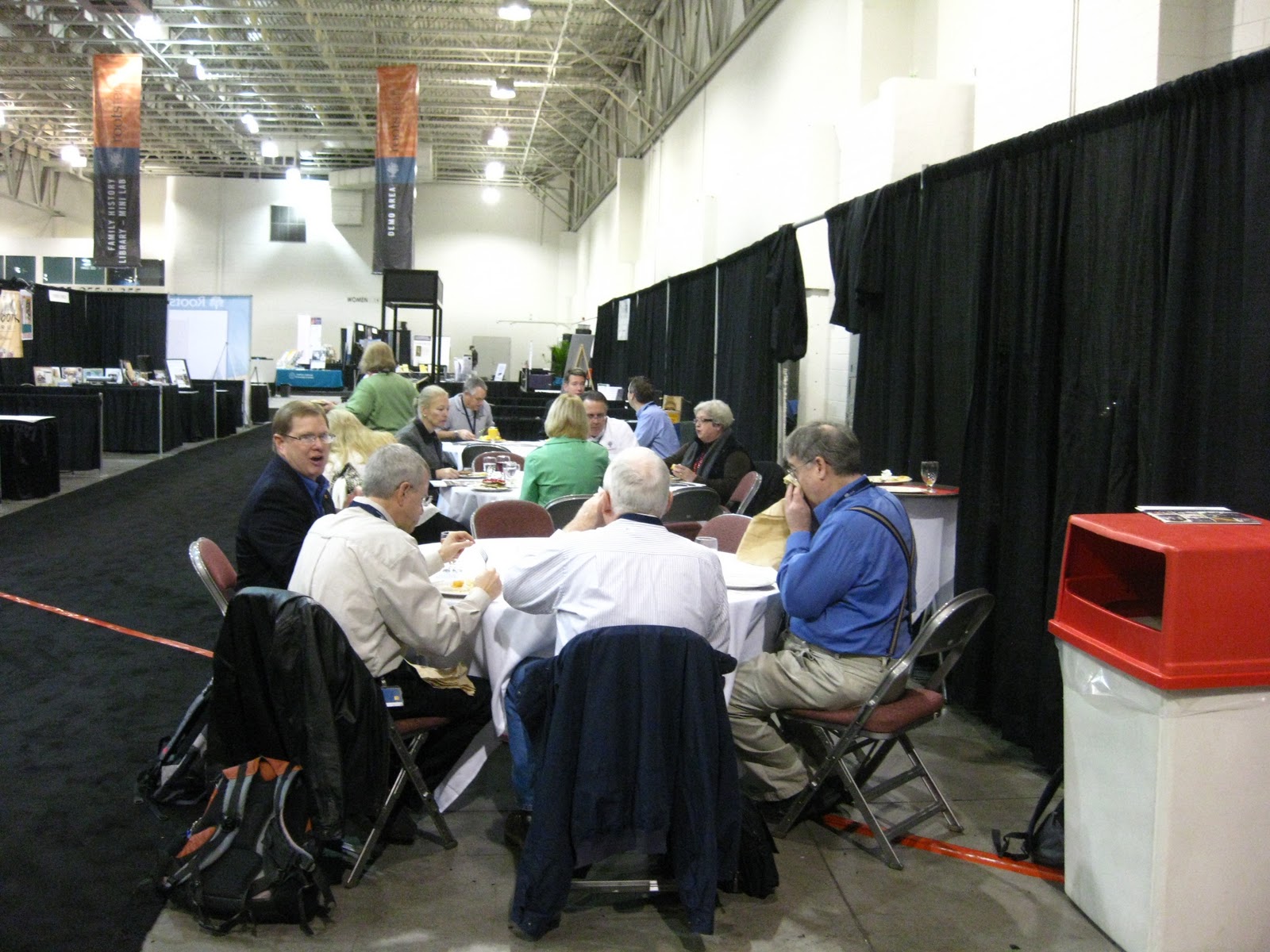
After filling us with food, FamilySearch shared their vision for 2011 and RootsTech in the Demo Area. They had couches, and it was good.

Jim Ericson addressed the group.

Then we got a tour of the Community Zone before it opened to the masses. That's why it looks empty.

Microsoft sponsored a little playground area, were attendees could play games and relax after a long day of interacting and networking. The minute the hall opened, some of the tech guys made a beeline for this area. Guess they already needed relaxing.

The RootsTech folks even offered some collaborative meeting space within the Community Zone. I appreciated this because it shows they know a lot of learning at conference happens outside traditional speaker-and-audience sessions.

After our tour, it was time to head off to the opening keynote address, but that will come in a later post.
Thursday, February 10, 2011
2011 RootsTech Update 2
Yesterday, I had the pleasure of seeing the Distribution and Print Center for the Church of Jesus Christ of Latter-day Saints in Salt Lake City at the invitation of FamilySearch. This was really a privilege, as this building usually isn't open to the public.
Housed in this building are the microfilms that are sent to local Family History Centers when requested. They also store and ship the items found on the LDS online store. There are over 2,000 different types of products inside.
I was part of a small media tour. We weren't allowed to take pictures, but the nice folks at FamilySearch provided some stock photos. Here is a view of the outside of the building.

Here are some stats on the building:
It covers 1,097,419 square feet, about as much as 19 football fields.
725,000 rolls of microfilm are stored inside.
This distribution center fills around 1.6 million film orders a year.
If you order a microfilm from a Family History Center, it likely ships from here, or from another Distribution Center on your continent.
The whole microfilm retrieval process is automatic. There are floor-to-ceiling drawers full of barcoded boxes of microfilm. There's a little robotic retriever that moves back and forth in an aisle, pulls the requested drawers and delivers them to employees.
A computer system tells the little machine where to go, up or down and which drawer to pull. Here is a shot of a film aisle:

Once the film drawer comes forward, the requested box(es) of microfilm are manually removed from the drawer by an employee. These items are scanned and sorted each step of the way, until they get put in a box for shipping.

The employees fulfilled some orders while we were there (after closing time) so we could see the process. The entire warehouse system is top of the line and very efficient. In the portion we toured, it was staffed by only 2 employees. That's all that was needed to fill all those orders!
I really enjoyed this tour from an information perspective and a fulfillment perspective.
After the tour, we had dinner at The Roof, which is a rooftop restaurant in Salt Lake City. I met Jill Ball of the Genaius blog, all the way from Australia! She's a hoot. She kept calling all the other bloggers "stars" but she's a celebrity in her own right.
After dinner, I met up with some other bloggers in the hotel bar. Lisa Alzo, Joan Miller, Thomas MacEntee, Lorine Schulze Massey and others.
It was a great day, and the conference hadn't even started yet! More to come....
Wednesday, February 9, 2011
2011 RootsTech Update 1

Greetings from Salt Lake City! I'm in town for RootsTech, and the coming posts the next few days will be about the conference.
I arrived yesterday, and had a nice dinner with Mr. and Mrs. Luxegen.
This morning I did a little searching at the Family History Library. I met with some lovely bloggers and genealogy types for lunch. Our little party had representatives from four countries! They come from all over for this event.
This afternoon, I'm part of the media tour of the FamilySearch Film Distribution Center. In the evening, I get to mingle with other official RootsTech bloggers and FamilySearch staff.
Today is a travel day for many of the conference attendees. The show officially starts tomorrow.
More updates to come!
Monday, February 7, 2011
Interview with RootsTech Speaker Janet Hovorka

Recently, I had the pleasure of interviewing Janet Hovorka of Generation Maps and the popular The Chart Chick blog. She is speaking and exhibiting at the upcoming RootsTech conference. Below, she discusses the sessions she's teaching and the conference in general:
1. Why did you choose to speak at RootsTech? What makes it different than other types of genealogy conferences?
RootsTech is going to be a very different type of conference for me since I fall into the category of lecturer, vendor and student. With Generation Maps, we are not only teaching about our products and displaying them in the vendor's space, but we are also able to participate in this conference as developers, being there to learn from the users about what is needed so that they can be better genealogists. At every conference we go to we are always listening for how people interact with our products and what their needs are, but this conference is different because of the collaborative environment that has been set up for users to interact more formally with the developers to express their needs in genealogy. It will be interesting to see how that all works out. I'm sure we'll be very busy but I'm also sure it is going to be a very productive conference too.Besides our vendor's demos, I've chosen to speak at RootsTech about two issues we see constantly in our genealogy business--two issues I care about very much. "Will Your Work Survive the Digital Age" is about digital archiving and how the user can ensure that their research is available for future generations to investigate and build on. We hear over and over about how people have scanned in all their pictures and have everything organized on the computer. And yet could you really lay your hands on something you did on the computer 10 years ago, or 15 years ago, or 20 years ago? And if you do still have it, and can still find it, could you open it up on the computer you have today? Our world has gone digital. My Grandparents' courtship was through letters, my courtship was through emails and over the phone, and my younger sisters' courtships were through text messages. But it will be much easier for my grandchildren to read about my grandparents' courtship than about mine or my sisters'. In some ways we are creating a digital dark age, and this first lecture is about how to make sure your genealogy research survives that situation.
My second session is about "Playground Rules for the Genealogy Playground." I've written about this some on my blog but I'm looking forward to hearing what the participants at this conference have to say on this subject. At Generation Maps we are in a unique position in the industry. Unlike most of the other companies whose products you purchase and use when you are starting or working on collecting your family history, our products are used when you have collected some of your family history already. We have people send us files from all over the world for custom and regular chart printing and I get to see the end result of a large amount of research. Those files don't go anywhere else, and we delete them after the chart is printed, but we've seen many, many family history computer files. As a librarian by training, I've noticed that often the documentation has not been collected as well as the other information. I've been increasingly concerned about the collaborative databases out on the internet, the research that people have contributed to the databases is sometimes given with documentation and sometimes not. Likewise, it used to be that when you would write a cousin for information about the family, they would send you all the information they had from vital records or maybe the family bible. Now, when you contact a genealogist cousin, you may get a computer file--and depending on how diligent that cousin is about entering the sources they used to collect the information into the computer, you may or may not find anything on where that information came from. This becomes a real problem when you collaborate with lots of genealogist cousins and and come into conflicting information. We have to make sure the source citations are attached to information out on the internet so that we can effectively analyze sources against each other.
2. Your session looks at the Internet as a collaborative space for genealogy. How important is collaboration in family history research today?
Collaboration is fabulous. More information is more information is more information and that's always a good thing when you are researching about your family. But we have to keep in mind a couple of things. First and foremost, we need to share not only the information we have about our ancestors, but also the sources about where we found that information. Then when future generations find conflicting information, they will be able to analyze the sources against each other and come to the truth. If we create genealogy databases and resources without the supporting documentation, future generations will have very little to build on.Secondly, we need to remember that there are different levels of researchers. Some of the collaboration will come from newbies who will believe anything they see on the internet. I have a friend who collaborates with her very active genealogist Uncle. When she asks him about something in his research, he says "I don't know--I found it on the internet." Being a more careful researcher herself, she uses his research as pointers, and then looks for more thorough documentation. Beginners are fine--everyone was one at one time. You just have to be careful not to take everything at face value.
And we need to play nicely with each other. It is often easy to say things through the computer that you would say in a more gentle way in real life. As you interact with others about their family history through the internet, it is really important to be kind. Especially when you are discussing someone's family history. Your family's history is the core of who you personally are so it can be a highly charged and emotional topic for some people.
3. What can attendees expect from your session?
I'm really looking forward to the collaborative environment of this conference and getting some feedback from attendees on these ideas. I've given these presentations before in other situations, but there hasn't been as much back and forth discussion on the topics as I'm anticipating here. I'm looking forward to discussing these ideas and other issues pertaining to Generation Maps products with the attendees.
I'm really looking forward to the collaborative environment of this conference and getting some feedback from attendees on these ideas. I've given these presentations before in other situations, but there hasn't been as much back and forth discussion on the topics as I'm anticipating here. I'm looking forward to discussing these ideas and other issues pertaining to Generation Maps products with the attendees.
I'd like to thank Janet for sharing with me (and you) about her sessions and perspective on family history. You can see Janet at her Rootstech sessions, and stop by the Generation Maps booth #310 in the free RootsTech exhibit hall.
Disclosure: I am an Official Blogger for the RootsTech conference, and will periodically write about the event in this capacity. This perk includes complimentary registration to the event.
Sunday, February 6, 2011
Genealogy Showdown: It's on Like Donkey Kong
I'm in the middle of a genealogical double duel.
It began with a simple meeting between friends. My pal The Family Curator and I met during the holidays and talked of genealogy resolutions. We each came up with our own and promised to support each other through the year, figuring a little buddy system pressure would help us both. I wrote about the meeting and my goals here. Denise wrote about hers here.
Then Sheri The Educated Genealogist and Cheryl of Heritage Happens met up in Northern California and came up with some 2011 goals of their own. Here are Sheri's and Cheryl's posts on the subject.
After that, Denise posted an update her progress in her personal genealogy challenges here. If you read the very end of her post, she proposes a team challenge with me, facing Sheri and Cheryl. In the comments, Sheri utters the phrase "double dog dare." Know what that means?
IT'S ON!
Now, I have no idea exactly what's *on,* but I am ready to face the girls of Northern California. Though I live in Texas, I'm SoCal born and raised. And I'll gladly represent my home turf along with The Family Curator.
So somehow our little two person goal-setting meeting turned into a double dog dare with a showdown at the 2011 Southern California Genealogy Jamboree. Keep in mind, I have no idea what the challenge actually is or how we're going to measure it. What I do know is that the gloves are off and I will have great fun trash talking with the ladies from the north for the next few months.
This whole development has really been hilarious, but now I really have to get to work. Team SoCal has a challenge to win. Yeah I said it, I meant it, and I'm here to represent it. See you in Burbank, ladies.
It began with a simple meeting between friends. My pal The Family Curator and I met during the holidays and talked of genealogy resolutions. We each came up with our own and promised to support each other through the year, figuring a little buddy system pressure would help us both. I wrote about the meeting and my goals here. Denise wrote about hers here.
Then Sheri The Educated Genealogist and Cheryl of Heritage Happens met up in Northern California and came up with some 2011 goals of their own. Here are Sheri's and Cheryl's posts on the subject.
After that, Denise posted an update her progress in her personal genealogy challenges here. If you read the very end of her post, she proposes a team challenge with me, facing Sheri and Cheryl. In the comments, Sheri utters the phrase "double dog dare." Know what that means?
IT'S ON!
Now, I have no idea exactly what's *on,* but I am ready to face the girls of Northern California. Though I live in Texas, I'm SoCal born and raised. And I'll gladly represent my home turf along with The Family Curator.
So somehow our little two person goal-setting meeting turned into a double dog dare with a showdown at the 2011 Southern California Genealogy Jamboree. Keep in mind, I have no idea what the challenge actually is or how we're going to measure it. What I do know is that the gloves are off and I will have great fun trash talking with the ladies from the north for the next few months.
This whole development has really been hilarious, but now I really have to get to work. Team SoCal has a challenge to win. Yeah I said it, I meant it, and I'm here to represent it. See you in Burbank, ladies.
Saturday, February 5, 2011
Free Online Sessions at RootsTech
RootsTech Conference Will Broadcast
Select Sessions Free Online
SALT LAKE CITY—RootsTech, a new family history and technology conference held in Salt Lake City, Utah, February 10-12, 2011, announced today that six of its popular sessions will be broadcasted live and complimentary over the Internet. The live broadcasts will give those unable to attend worldwide a sample of this year’s conference content. Interested viewers can watch the live presentations at RootsTech.org. The first-year conference has attracted over 2,000 registered attendees.
The free online sessions include some of the keynote speakers and a sampling of technology and family history presentations. Following are the six broadcasts, speakers, and times of the presentations. All times are in Mountain Standard Time (MST):
Thursday, February 10, 2011
· 8:30-9:00 a.m., A world of Information, Shane Robison, chief technology officer, Hewlett Packard· 9-9:30 a.m., Turning Roots, Branches, Trees into Nodes, Links, Graphs, Jay L. Verkler, chief executive officer, FamilySearch International
· 3-4:00 p.m., Digitally Preserving Your Family Heritage, Barry Ewell, founder of MyGenShare.com
Friday, February 11, 2011
· 8:30-9:30 a.m., The Changing Face of Genealogy, by Curt Witcher, manager of the Historical Genealogy Department, Allen County Public Library· 9:45-10:45 a.m., Cloud Computing: What is it and how it has been used to create the next familysearch.org, by Brian Pugh, senior engineer, FamilySearch International
Saturday, February 12, 2011
· 8:30-9:30 a.m. Personal Archiving and Primary Documents, Brewster Kahle, founder of the Internet Archives· 1:45-2:45 p.m., Virtual Presentations Round Table and Collaborative Panel Discussion, Thomas MacEntee, professional genealogist and technology specialist
· 3:00-4:00 p.m., The Power of PDF: Tools for Every Genealogist , D. Josh Taylor, Director of Education and Programs at New England Historical Genealogical Society.
About RootsTech
RootsTech is a new conference designed to bring technologists together with genealogists to learn from each other and find solutions to the challenges faced in family history research today. The conference’s activities and offerings are focused on content that will help genealogists and family historians discover exciting new research tools while enabling technology creators to learn the latest development techniques from industry leaders and pioneers.
Friday, February 4, 2011
Genealogy 411 for February 4, 2011

Our family truckster in my grandparents' driveway
in Wrightwood, California, circa 1980
The picture above has nothing to do with this post, but it seems to fit the overall theme of the past few days.
I took a week off from blogging, and boy did it feel good. I needed a break, plus I had a lot of inquiries coming at me from all sides. I was so busy responding to others, that I couldn't focus enough to write here. Now I've had my break and I'm gearing up for RootsTech. Here are some of the news stories I collected in the past week and put in one place:
Archives.com published a chart of Online Family History Trends.
Registration is open for the 2011 Federation of Genealogical Societies Conference in Springfield, Illinois.
There is an event called "Super Indexing Sunday,"where folks do volunteer indexing at FamilySearch on February 6. There's something else going on that day, but it shouldn't interfere, right?
Getting Started on Ancestry.com webinar, Monday, February 7, 2011 at 8:00PM EST. In fact, there are several Ancestry.com webinars in the near future. See them here and watch videos of past webinars.
There's a Family Tree Maker webinar on February 16. Click the link for information on how to sign up.
RootsMagic has several webinars in their future as well. Click here to sign up or watch past presentations.
Finally, Who Do You Think You Are season 2 starts tonight. Glad I looked because it's on at 7 here.
Guess that's it for now. Go forth and find your family's history! Or take a nap. Up to you.
Subscribe to:
Posts (Atom)